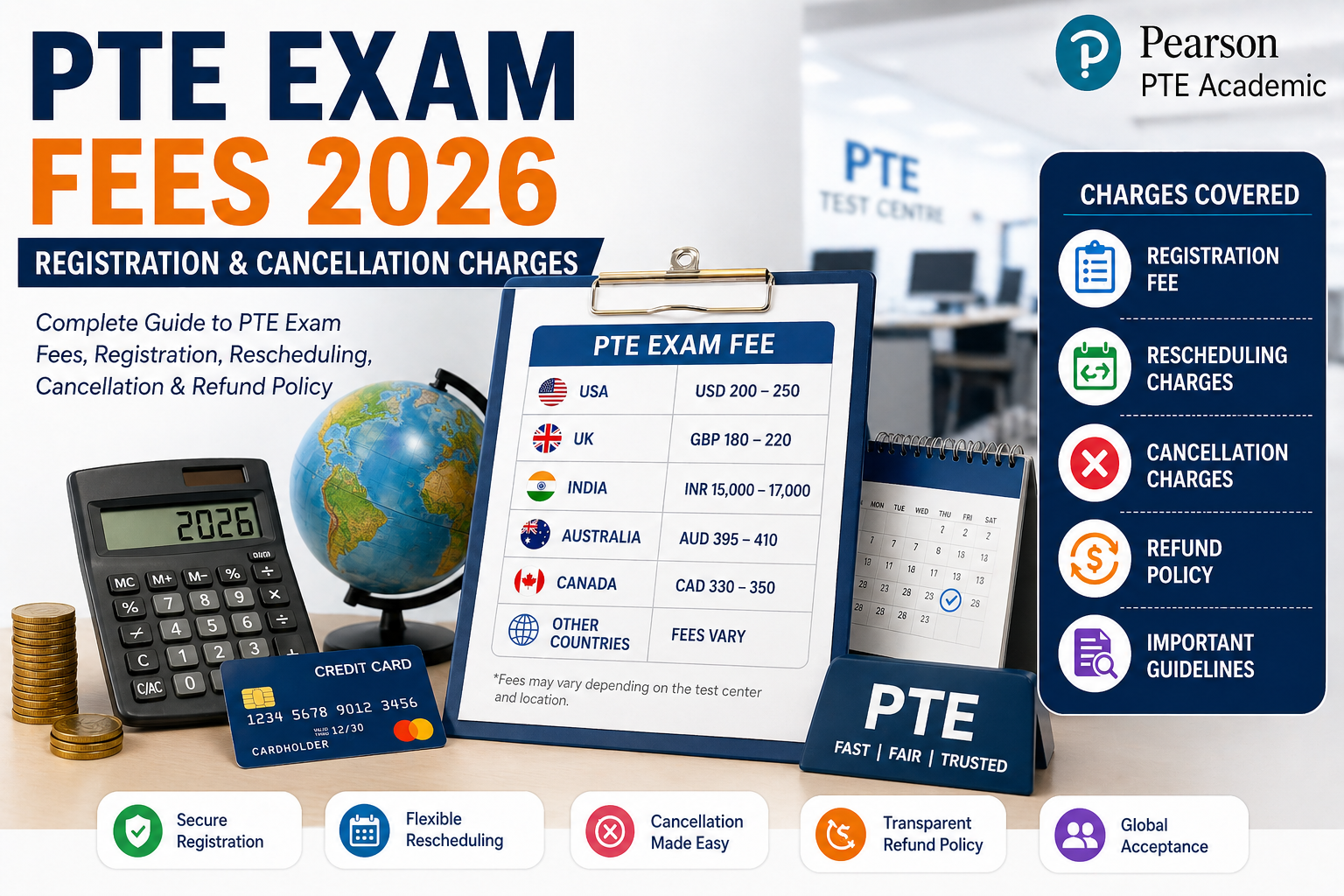
pte exam fees 2026 registration cancellation rescheduling charges cost

PTE Exam Fees 2026: Registration & Cancellation Charges

If you’re planning to take the PTE exam, then understanding PTE exam fees should be your first step. After all, the PTE exam fee is not just about the base cost; it also includes registration charges, cancellation fees, and rescheduling costs that can significantly affect your budget.

The Pearson PLC conducts the PTE Academic, one of the most popular English proficiency tests worldwide. Because of its fast results and flexible scheduling, many students and professionals prefer it for study, work, and migration purposes.

In this detailed guide, you will learn everything about PTE exam fees 2026, including country-wise costs, registration details, cancellation policies, rescheduling charges, and practical strategies to avoid unnecessary expenses.

🟦 PTE Exam Fees Overview

To begin with, the PTE exam fee is not fixed globally. Instead, it varies depending on your country, test center, and the type of PTE exam you choose.

Generally, the PTE exam fee includes:

  • Registration cost
  • Test center charges
  • Administrative fees

However, additional costs may apply if you make changes to your booking. Therefore, understanding the full fee structure is essential before registering. To avoid paying multiple times, proper preparation is essential.

🟦 PTE Exam Fee by Country (2026)

Although fees vary across regions, the pricing falls within a predictable range. Below is a general overview.

🌍 PTE Exam Fee in the United States

In the U.S., the PTE exam fee typically ranges between:

  • $200 – $250

Because of higher operational costs, fees tend to be slightly higher here.

🌍 PTE Exam Fee in the United Kingdom

In the UK, candidates usually pay:

  • Β£180 – Β£220

🌍 PTE Exam Fee in India

India remains one of the most popular locations for PTE test-takers.

  • β‚Ή15,000 – β‚Ή17,000

As a result, test slots can fill quickly.

🌍 PTE Exam Fee in Australia

In Australia, candidates typically pay:

  • AUD 395 – AUD 410

🌍 PTE Exam Fee in Canada

For Canada, the exam cost usually falls between:

  • CAD 330 – CAD 350

🌍 PTE Exam Fee in Other Countries

Across other regions, pricing can vary significantly. For example, candidates in Europe, Africa, and Asia may see different rates depending on the test center. Therefore, it is always best to check your local center for the most accurate and up-to-date fee.

🟦 PTE Exam Registration Charges

Registering for the PTE exam is straightforward. However, timing plays a crucial role in determining how much you pay. You can register for the exam directly through the official PTE booking portal.

🟨 Standard Registration Fee

The standard registration fee is included in the base exam fee. When you book your test early, you typically pay only the standard cost.

🟨 Late Registration Charges

If you book close to your exam date, additional charges may apply. Therefore, booking early is always recommended.

🟨 How to Register for PTE

You can register online through the official Pearson website. The process includes:

  1. Creating an account
  2. Selecting your test center
  3. Choosing a date
  4. Making payment

Because the process is digital, it is quick and convenient. Understanding the exam structure can help reduce unnecessary attempts.

🟦 PTE Cancellation Charges

Understanding cancellation policies is crucial. Otherwise, you may lose a significant portion of your fee.

🟨 Cancellation More Than 14 Days Before Exam

If you cancel your booking at least 14 days in advance, you may receive a partial or full refund depending on local policies.

🟨 Cancellation Within 7–14 Days

If you cancel within this window, you may receive only a partial refund.

🟨 Cancellation Within 7 Days

No refund is typically provided if you cancel within 7 days of your exam.

Because of these rules, planning your schedule carefully is essential.

🟦 PTE Rescheduling Charges

Sometimes, you may need to change your exam date. In such cases, rescheduling fees apply.

🟨 Free Rescheduling

You can reschedule your exam without additional charges if done well in advance.

🟨 Paid Rescheduling

If you reschedule close to the test date, you may need to pay a fee.

Therefore, it is always best to finalize your schedule before booking.

🟦 PTE Retake Fees

If you do not achieve your desired score, you can retake the exam. However, you must pay the full PTE exam fee again.

Because of this, proper preparation becomes extremely important. Otherwise, multiple attempts can significantly increase your overall cost.

🟦 Payment Methods for PTE Exam Fees

Payment for the PTE exam is flexible and convenient. Typically, you can use:

  • Credit cards
  • Debit cards
  • PayPal
  • Online payment systems

Because payments are processed online, booking your exam is fast and secure.

🟦 Refund Policy Explained

Refund policies vary slightly by region. However, general guidelines include:

  • Full refund: Rare
  • Partial refund: Possible if canceled early
  • No refund: Close to exam date

Therefore, always read the terms carefully before confirming your booking.

🟦 Is the PTE Exam Fee Worth It?

At first glance, the fee may seem high. However, the benefits often justify the cost.

🟨 Key Advantages

  • Fast results (within 48 hours)
  • Widely accepted globally
  • AI-based scoring system

As a result, many candidates choose PTE for its efficiency and reliability.

🟦 Tips to Save Money on PTE Exam Fees

Fortunately, there are several ways to reduce your expenses.

🟨 Book Early

Booking early helps you avoid late fees. In addition, it gives you more flexibility in choosing dates.

🟨 Avoid Last-Minute Changes

Rescheduling or canceling late can be expensive. Therefore, plan your schedule carefully.

🟨 Prepare Thoroughly

Strong preparation reduces the risk of retaking the exam. As a result, you save money.

🟨 Look for Discounts

Occasionally, Pearson offers discounts or vouchers. Therefore, keep an eye out for promotions. If you want to skip retakes and save money, consider faster alternatives.

🟦 PTE vs Other Exam Fees

Comparing PTE with other exams helps you make informed decisions.

🟨 PTE vs IELTS

  • Similar cost
  • Faster results in PTE

🟨 PTE vs TOEFL

  • Comparable pricing
  • Different test format

Ultimately, your choice depends on your goals and preferences.

🟦 Common Mistakes to Avoid

Many candidates lose money due to avoidable mistakes.

  • Booking late
  • Rescheduling frequently
  • Underestimating preparation
  • Ignoring refund policies

Instead, take a structured approach to avoid unnecessary costs.

🟦 FAQs About PTE Exam Fees

❓ How much is the PTE exam fee?

It typically ranges between $200 and $250.

❓ Is the fee the same worldwide?

No, it varies depending on location.

❓ Can I get a refund?

Partial refunds may be available if you cancel early.

❓ Do I need to pay again if I fail?

Yes, you must pay the full fee again.

❓ Are there hidden charges?

There are no hidden charges, but additional fees may apply for late booking or changes.

🟒 Conclusion

Understanding PTE exam fees 2026 is essential before booking your test. Because costs include registration, cancellation, and rescheduling charges, planning ahead can save you a significant amount of money.

However, despite the cost, the PTE exam offers excellent value. In the end, it provides a fast, reliable, and widely accepted way to prove your English proficiency.

Therefore, treat the exam fee as an investment in your future rather than just an expense.

goethe exam fees 2026 cost breakdown a1 to c2 levels

Goethe Exam Fees 2026: Complete Cost Breakdown for All Levels (A1–C2)

Planning to take a German language certification? Then, understanding Goethe exam fees should be your first priority. After all, Goethe exam fees vary depending on the level, location, and test center, which can significantly affect your budget.

The Goethe-Institut conducts German language exams worldwide. Because of its global recognition, this certification is widely accepted for study, work, and immigration purposes. As a result, thousands of candidates register every year.

In this detailed guide, you’ll learn everything about Goethe exam fees, including level-wise pricing, additional costs, refund policies, and practical strategies to reduce expenses. By the end, you’ll have a clear understanding of what to expect financially. If you’re exploring different language exams, understanding their costs and formats can help you plan better.

🟦 Goethe Exam Fees Overview

To begin with, it’s important to understand that Goethe exam fees are not fixed globally. Instead, they vary depending on the country and the specific Goethe center.

Generally speaking, the cost depends on:

  • Exam level (A1–C2)
  • Location
  • Candidate category (student or external candidate)

However, despite these variations, the fee structure follows a consistent pattern across all regions.

In addition, higher-level exams tend to cost more due to increased complexity and evaluation requirements. Therefore, your choice of level directly impacts your overall expense.

🟦 Goethe Exam Fee Structure by Level (A1–C2)

The Goethe exams follow the Common European Framework of Reference for Languages (CEFR) framework, as outlined on the official Goethe exam levels page. Because of this standardized system, each level reflects a specific language proficiency.

🟨 Goethe A1 Exam Fees (Beginner Level)

The A1 level is ideal for beginners. Naturally, it is the least expensive option.

Estimated fee range:

  • €80 – €150

At this stage, candidates are expected to understand simple phrases and basic communication. Therefore, many first-time learners begin with A1.

🟨 Goethe A2 Exam Fees (Elementary Level)

The A2 level builds on basic knowledge. As a result, the fee increases slightly.

Estimated fee range:

  • €100 – €180

In addition, candidates must demonstrate the ability to handle everyday conversations. Because of this, preparation becomes more important.

🟨 Goethe B1 Exam Fees (Intermediate Level)

B1 is a crucial milestone. In fact, it is often required for visas, residency, or citizenship.

Estimated fee range:

  • €150 – €250

Because of its importance, demand for this level is high. Therefore, booking early is recommended.

🟨 Goethe B2 Exam Fees (Upper-Intermediate Level)

The B2 level indicates independent language use. Moreover, it is required for many academic programs.

Estimated fee range:

  • €180 – €300

At this level, candidates must handle complex texts and discussions. Consequently, preparation time increases.

🟨 Goethe C1 Exam Fees (Advanced Level)

C1 represents advanced proficiency. As expected, the fee is higher.

Estimated fee range:

  • €200 – €350

In addition, many universities and employers require this level. Therefore, it is a valuable investment.

🟨 Goethe C2 Exam Fees (Proficiency Level)

C2 is the highest level. At this stage, candidates demonstrate near-native fluency.

Estimated fee range:

  • €250 – €400

Because of its difficulty, fewer candidates attempt this level. However, it offers maximum recognition.

🟦 Goethe Exam Fees by Country

Although the structure remains consistent, fees differ across regions. For example, European countries often have lower fees compared to other regions.

🌍 Regional Comparison

  • Europe: Generally lower fees
  • Asia: Moderate pricing
  • Africa: Slight variations depending on center

Therefore, it is always best to check your local Goethe-Institut center for exact pricing.

Additionally, currency exchange rates may affect the final amount you pay. So, keep this in mind when budgeting.

🟦 Additional Costs Beyond Goethe Exam Fees

While the base fee covers the exam, there may be additional expenses. In many cases, candidates overlook these costs.

🟨 Registration Fees

Some centers include this in the total cost. However, others charge separately.

🟨 Late Registration Fees

If you miss the deadline, you may need to pay extra. Therefore, early registration is highly recommended.

🟨 Retake Fees

If you fail the exam, you must pay again. In most cases, the full fee applies.

Because of this, proper preparation is essential to avoid additional expenses.

🟨 Certificate Reissue Fees

If you lose your certificate, you may need to pay for a replacement.

🟨 Study Materials and Coaching Costs

Although optional, preparation materials can add to your total expense.

Examples include:

  • Books
  • Online courses
  • Practice tests

Therefore, budgeting for preparation is also important.

🟦 Payment Methods for Goethe Exam Fees

Payment methods vary by location. Typically, candidates can use:

  • Credit or debit cards
  • Bank transfers
  • Online payment systems

In some centers, cash payments are also accepted. However, online payments are more common.

🟦 Refund and Cancellation Policy

Before registering, you should understand the refund policy. Otherwise, you may face unexpected losses.

Generally speaking:

  • Full refunds are rare
  • Partial refunds may be available before deadlines
  • No refunds after the cutoff date

Therefore, always confirm the policy with your test center.

🟦 Is the Goethe Exam Worth the Cost?

The fees may seem high. However, the benefits often justify the investment.

🟨 Key Advantages

  • Globally recognized certification
  • Required for German visas and universities
  • Enhances job opportunities

As a result, many candidates consider it a long-term investment.

Moreover, passing a higher level can open doors to better opportunities. Therefore, the return on investment is significant.

🟦 Tips to Save Money on Goethe Exam Fees

Fortunately, there are several ways to reduce costs. If you plan strategically, you can avoid unnecessary expenses. Check out our Goethe exam preparation course to boost your chances of success.

🟨 Register Early

Early registration helps you avoid late fees. In addition, it ensures seat availability.

🟨 Choose the Right Level

Selecting the correct level is crucial. Otherwise, you may need to retake the exam.

🟨 Prepare Thoroughly

Strong preparation reduces the risk of failure. Therefore, you save money in the long run.

🟨 Look for Discounts

Some centers offer discounts for students or members. So, check eligibility before applying.

🟨 Avoid Multiple Attempts

Each retake adds to your cost. Therefore, aim to pass on your first attempt.

🟦 Goethe Exam Fees vs Other Language Exams

Comparing exam costs can help you decide wisely. For instance, exams like IELTS and TOEFL have similar pricing.

🟨 Compared to IELTS

  • Similar cost at higher levels
  • Different language focus

🟨 Compared to TOEFL

  • Comparable pricing
  • Used for English proficiency

Ultimately, your choice depends on your goals.

🟦 Common Mistakes Related to Goethe Exam Fees

Many candidates make avoidable mistakes. However, you can prevent them with proper planning.

  • Registering late
  • Choosing the wrong level
  • Ignoring refund policies
  • Underestimating preparation costs

Instead, take a structured approach.

🟦 FAQs About Goethe Exam Fees

❓ How much is the Goethe exam fee?

Fees typically range from €80 to €400 depending on the level.

❓ Are fees the same worldwide?

No. Instead, they vary by country and test center.

❓ Can I get a refund?

Partial refunds may be available. However, conditions apply.

❓ Do I pay again if I fail?

Yes. In most cases, you must pay the full fee again.

❓ Are there discounts available?

Some centers offer discounts for students.

🟒 Conclusion

Understanding Goethe exam fees is essential before registering. Because costs vary, checking your local center is always the best approach.

However, despite the expense, the certification offers significant long-term benefits. In the end, it can open doors to education, career growth, and migration opportunities.

Therefore, treat the exam fee not as a cost but as an investment in your future.

inbde exam format 2026 structure question types dental board exam

INBDE Exam Format 2026: Complete Guide to Structure, Sections & Question Types

Preparing for the INBDE exam can feel overwhelming at first. However, once you understand the structure, the process becomes much more manageable. That’s why this INBDE exam format guide breaks everything down step by step.

The Integrated National Board Dental Examination (INBDE) is administered by the Joint Commission on National Dental Examinations (JCNDE). Because it replaces older exams, it follows a more integrated and clinically focused approach.

In this guide, you will learn about the exam structure, sections, question types, and scoring system. By the end, you’ll have a clear roadmap for preparation. If you’re comparing different healthcare and professional exams, understanding their formats can help you prepare better.

🟦 INBDE Exam Format Overview

To begin with, let’s look at the overall structure.

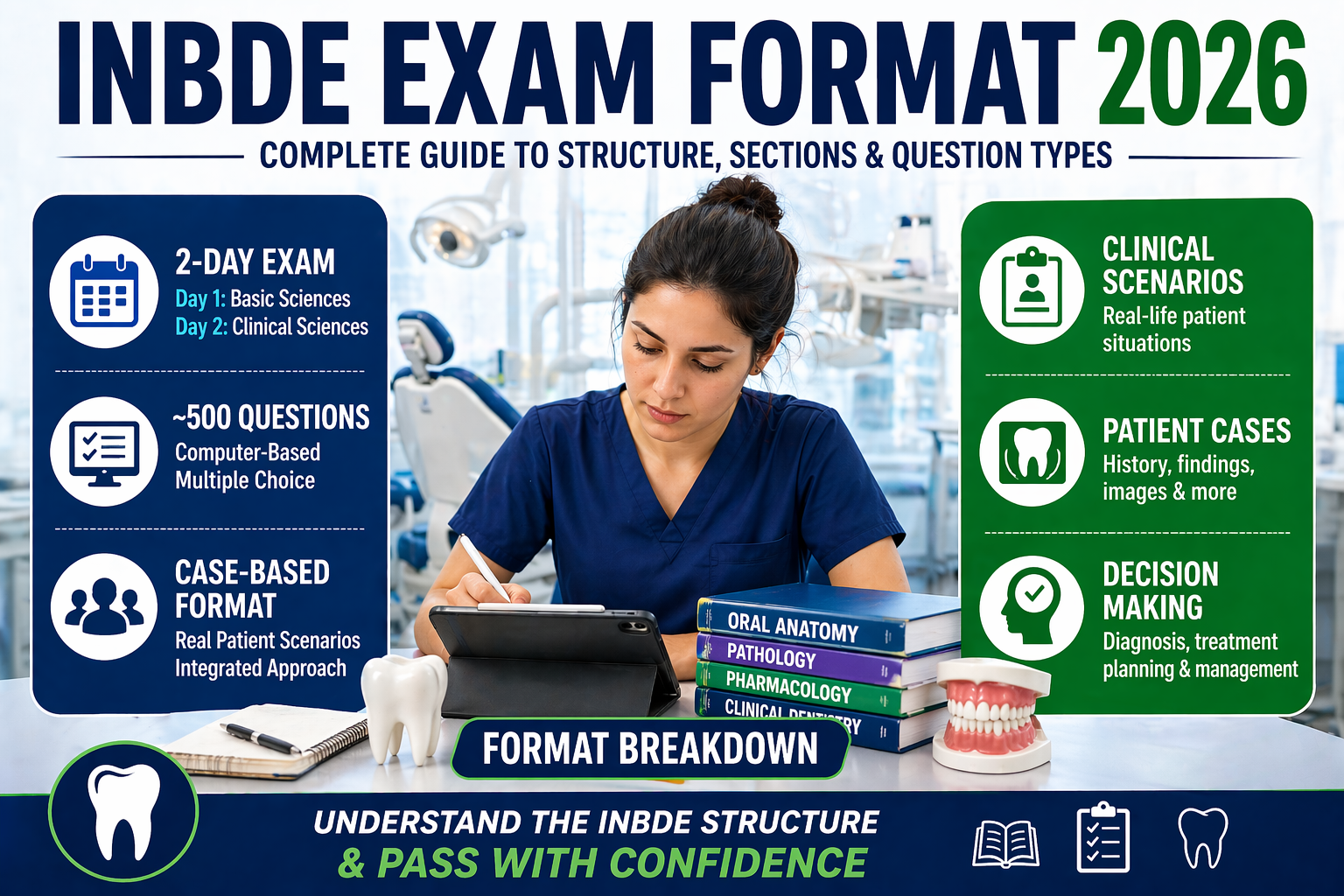
The INBDE is a computer-based exam that tests both knowledge and clinical decision-making. Unlike traditional exams, it integrates multiple subjects into real-life scenarios.

πŸ“Š Key Highlights

  • Total duration: 2 days
  • Total questions: approximately 500
  • Question type: Multiple-choice
  • Format: Case-based + standalone

Because of this format, candidates must connect concepts across different subjects rather than study them separately.

🟦 INBDE Exam Format Structure (Day 1 & Day 2)

Understanding how the exam is divided is essential. In fact, it directly impacts how you should prepare.

🟨 INBDE Exam Format Day 1 Breakdown

Day 1 focuses on core dental sciences. At the same time, it introduces clinical applications through case-based questions.

Topics include:

  • Basic sciences
  • Anatomy
  • Physiology
  • Pathology

In addition, you will encounter patient-based scenarios. As a result, you must apply your theoretical knowledge in practical contexts.

🟨 INBDE Exam Format Day 2 Breakdown

Day 2 shifts focus toward patient care. In other words, it emphasizes real-world decision-making.

Key areas include:

  • Diagnosis
  • Treatment planning
  • Patient management
  • Oral health care

Because of this shift, many candidates find Day 2 more challenging. Nevertheless, strong preparation makes it manageable.

🟦 INBDE Exam Format: Question Types Explained

The INBDE includes different types of questions. Each type tests a specific skill, so understanding them is crucial.

🟨 INBDE Exam Format Standalone Questions

These are direct multiple-choice questions. For example, they may test definitions or basic concepts.

Although they seem simple, accuracy is still important.

🟨 INBDE Exam Format Case-Based Questions

Case-based questions present detailed patient scenarios. After that, multiple questions follow the same case.

Typically, a case includes:

  • Patient history
  • Clinical findings
  • Images or radiographs

Because these simulate real situations, critical thinking is required.

🟨 INBDE Exam Format Integrated Questions

These questions combine multiple subjects. For instance, a single question may involve pathology, pharmacology, and treatment planning.

As a result, candidates must think holistically rather than focus on one topic.

🟦 INBDE Exam Format Content Areas

The exam covers a wide range of subjects. However, they are tested in an integrated manner.

🟨 Major Areas

  • Biomedical sciences
  • Clinical sciences
  • Behavioral sciences
  • Patient care

Therefore, understanding concepts is more important than memorization.

🟦 INBDE Exam Format Scoring System

The scoring system is simple. At the same time, it changes how you approach the exam.

  • Results are Pass/Fail
  • No numerical score is provided

Because of this, your goal is competency, not perfection. In other words, focus on overall understanding.

🟦 INBDE Exam Format vs NBDE (Key Differences)

The INBDE replaced older exams. As a result, the preparation approach has changed significantly.

🟨 Main Differences

  • Integrated format vs subject-based
  • Clinical focus vs theory-heavy
  • Case-based vs standalone

Because of these changes, students must adapt their study strategies.

🟦 INBDE Exam Time Management Tips

Managing time is critical. Without proper pacing, even well-prepared candidates can struggle.

To stay on track:

  • Avoid spending too long on one question
  • Flag difficult questions
  • Maintain steady progress

Additionally, build stamina through practice tests.

🟦 INBDE Preparation Tips Based on Format

Understanding the format helps you prepare smarter. Therefore, align your strategy with the exam structure. A structured preparation strategy is essential for success in any exam.

🟨 Focus on Understanding

Instead of memorizing, focus on concepts. This is because the exam tests application.

🟨 Practice Case-Based Questions

Since the exam emphasizes cases, practice them regularly.

🟨 Take Mock Tests

Not only do mock tests improve confidence, but they also help with time management. Practicing with mock tests helps improve confidence and accuracy.

🟨 Review Weak Areas

Finally, identify and improve your weak points. Over time, this leads to better performance.

🟦 Common Mistakes to Avoid

Even strong candidates make mistakes. However, you can avoid them with awareness.

  • Ignoring case-based practice
  • Relying only on memorization
  • Skipping mock exams
  • Poor time management

Instead, maintain a balanced approach.

🟦 FAQs About INBDE Exam Format

❓ How many days is the exam?

The exam takes place over two days.

❓ Is the INBDE difficult?

Yes, but proper preparation makes it manageable.

❓ Is there negative marking?

No, there is no negative marking.

❓ How many questions are there?

There are approximately 500 questions.

🟒 Conclusion

Understanding the INBDE exam format is essential for success. Without this knowledge, preparation can feel confusing.

However, once you understand the structure, everything becomes clearer. As a result, you can study more efficiently and confidently.

In the end, success depends not only on what you study but also on how well you apply it. The American Dental Association also offers resources and updates related to dental licensure exams.

ccrn study exam guide 2026 exam preparation critical care nurses tips

CCRN Exam Study Guide 2026: Complete Prep Plan to Pass on Your First Try

Preparing for the CCRN exam can feel overwhelming, especially when you’re balancing long shifts, patient care responsibilities, and personal commitments. However, success becomes much more achievable with a clear plan, the right resources, and consistent effort. That’s why this CCRN exam study guide is designed to support you at every step.

The certification is administered by the American Association of Critical-Care Nurses (AACN). Because of its strong reputation, earning the CCRN credential can significantly boost your career opportunities. In addition, it improves your confidence and enhances patient outcomes.

In this guide, you will learn everything you need to pass the CCRN exam. From understanding the format to building a study plan, each section is designed to move you closer to success.

🟦 What Is CCRN Certification in This Study Guide?

The CCRN certification is a specialty credential awarded to nurses who care for critically ill patients. In simple terms, it validates your clinical knowledge and decision-making skills.

Unlike general nursing certifications, CCRN focuses heavily on critical care concepts. For example, these include cardiovascular stability, respiratory support, and neurological assessment. As a result, the certification is highly valued in intensive care settings.

Moreover, obtaining CCRN certification demonstrates your commitment to professional growth. Therefore, many employers view it as a sign of advanced competence.

🟦 CCRN Exam Format in This Study Guide

Before starting your preparation, understanding the exam format is essential. First of all, it helps reduce anxiety. Secondly, it allows you to plan your time effectively.

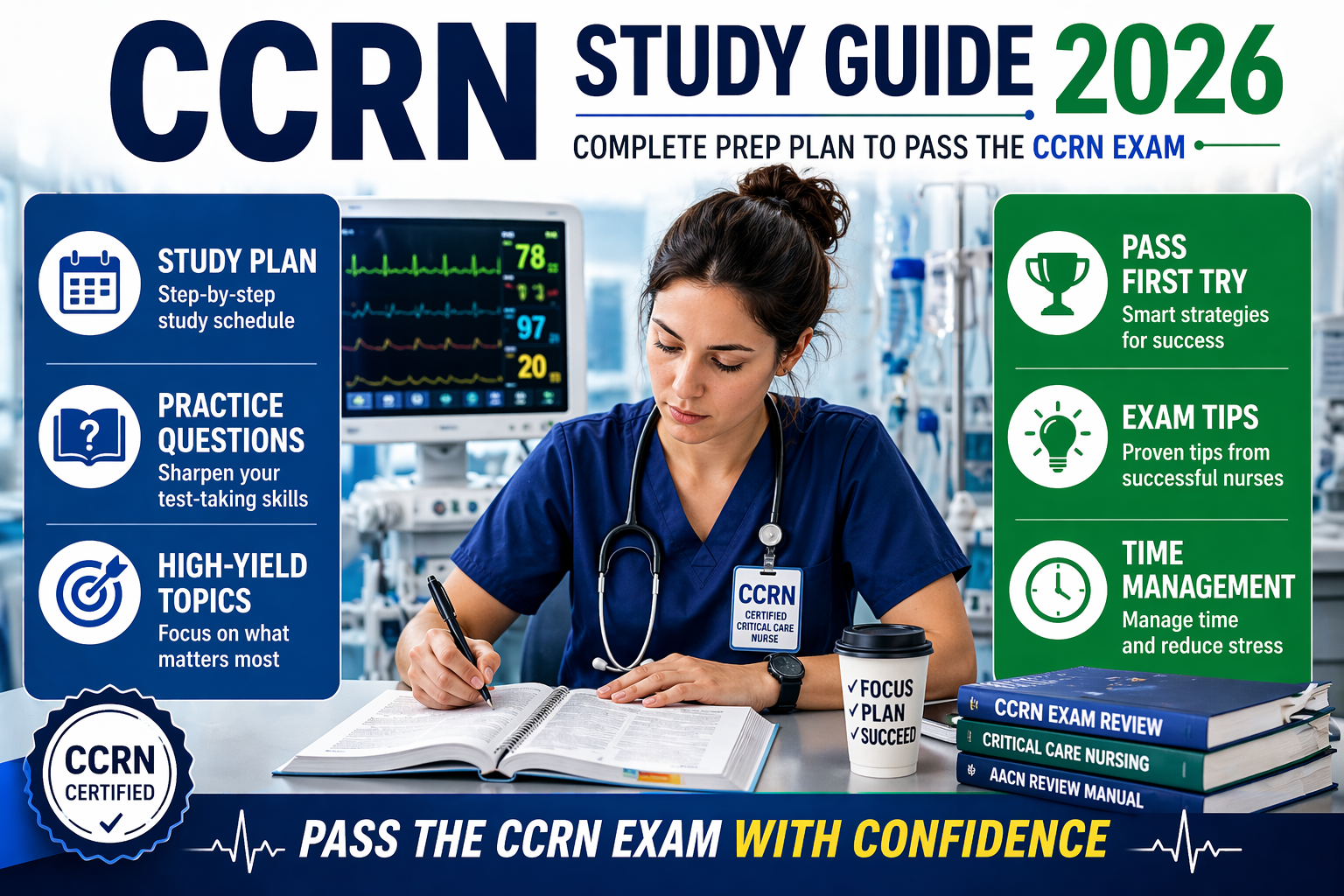
The CCRN exam includes:

  • 150 multiple-choice questions
  • 125 scored questions
  • 25 unscored pretest questions
  • 3-hour time limit

Although the number of questions may seem high, proper practice makes it manageable. On average, you have just over a minute per question.

Additionally, the exam is computer-based. Therefore, staying calm and focused is crucial. For a detailed breakdown of the exam structure, refer to the official CCRN exam handbook.

🟦 CCRN Exam Study Guide: Content Breakdown

The CCRN exam is divided into two main categories. Understanding this breakdown is important because it guides your study priorities.

🟨🟨 CCRN Exam Study Guide: Clinical Judgment Section (80%)

First and foremost, this section carries the most weight.

It includes:

  • Cardiovascular
  • Pulmonary
  • Neurology
  • Endocrine
  • Gastrointestinal
  • Renal

Because of this, you should dedicate most of your study time to these topics.

🟨 CCRN Exam Study Guide: Professional Practice Section (20%)

On the other hand, this section focuses on professional behavior.

It covers:

  • Advocacy
  • Ethics
  • Collaboration
  • Clinical inquiry

Even though it has less weight, it still plays an important role. Practicing with mock tests can significantly improve your performance.

🟦 How to Start Your CCRN Exam Study Guide Preparation

Getting started can feel difficult. However, a clear approach makes it easier.

First, review the exam blueprint provided by the American Association of Critical-Care Nurses. Next, assess your strengths and weaknesses.

After that, gather your study materials. Finally, create a realistic study schedule. Following a structured preparation strategy is essential for success in any exam.

🟦 Best Resources for Your CCRN Exam Study Guide

Choosing the right resources is essential. In fact, it can significantly impact your success.

🟨 Recommended Materials

  • Review books
  • Online courses
  • Practice question banks
  • Flashcards

In addition, video lessons can help explain complex topics. However, avoid using too many resources at once.

🟦 CCRN Exam Study Guide: 8-Week Study Plan

A structured plan keeps you consistent. More importantly, it prevents last-minute stress.

🟨 CCRN Exam Study Guide Week 1–2 (Foundation)

To begin with, focus on:

  • Cardiovascular
  • Respiratory

At this stage, prioritize understanding basic concepts.

🟨 CCRN Exam Study Guide Week 3–4 (Intermediate)

Next, move on to:

  • Neurology
  • Renal
  • Endocrine

At the same time, start practicing questions.

🟨 CCRN Exam Study Guide Week 5–6 (Advanced)

Then, cover:

  • Shock
  • Sepsis
  • Pharmacology

During this phase, increase your practice intensity.

🟨 CCRN Exam Study Guide Weeks 7–8: Final Review

Finally, focus on:

  • Mock tests
  • Weak areas
  • Time management

As a result, you’ll be exam-ready.

🟦 High-Yield Topics to Focus On

Not all topics are equally important. Therefore, focus on high-yield areas.

For example:

  • Hemodynamics
  • Ventilation
  • Cardiac rhythms
  • Shock management

Because these topics appear frequently, mastering them is essential.

🟦 CCRN Study Guide: Effective Study Techniques

🟨 Active Learning

Instead of passive reading, engage actively.

For instance:

  • Teach concepts
  • Write summaries
  • Draw diagrams

This approach improves retention.

🟨 Spaced Repetition

In addition, review topics regularly.

Over time, this strengthens memory.

🟨 Practice Questions

Most importantly, solve questions daily.

Not only does this improve accuracy, but it also builds confidence.

🟦 CCRN Study Guide: Common Mistakes to Avoid

Avoiding mistakes is just as important as studying.

  • Studying without a plan
  • Ignoring weak areas
  • Skipping practice

Instead, stay consistent and focused.

🟦 How Hard Is the CCRN Exam?

The exam is challenging. However, it is manageable with preparation.

Because it tests critical thinking, practice is essential.

🟦 Time Management Strategies

Time management is key. Without it, preparation can become stressful.

To stay on track:

  • Set daily goals
  • Study in short sessions
  • Take breaks

During the exam, manage your time wisely.

🟦 CCRN Exam Day Tips

Preparation doesn’t stop before the exam. In fact, exam-day habits matter.

  • Get enough sleep
  • Eat well
  • Stay calm

Most importantly, read each question carefully.

🟦 FAQs

❓ How long should I study?

Typically, 6–8 weeks is enough.

❓ Is CCRN worth it?

Yes, it boosts career growth.

❓ Can I pass on the first try?

Absolutely, with proper preparation.

🟒 Conclusion

Preparing for the CCRN exam requires dedication. However, a structured plan makes the process easier.

By following this CCRN exam study guide, you can stay focused and organized. In the end, consistent effort leads to success. If you’re exploring other healthcare exams, understanding their format and preparation strategies can also help.

oet vs ielts 2026 comparison healthcare professionals differences exam

OET vs IELTS 2026: Which Exam Is Better for Healthcare Professionals?

Choosing between OET and IELTS can feel confusing, especially for healthcare professionals planning to work abroad. Since both exams assess English proficiency, many candidates struggle to decide which option aligns with their goals. Therefore, understanding the differences between OET vs IELTS is essential before starting your preparation.

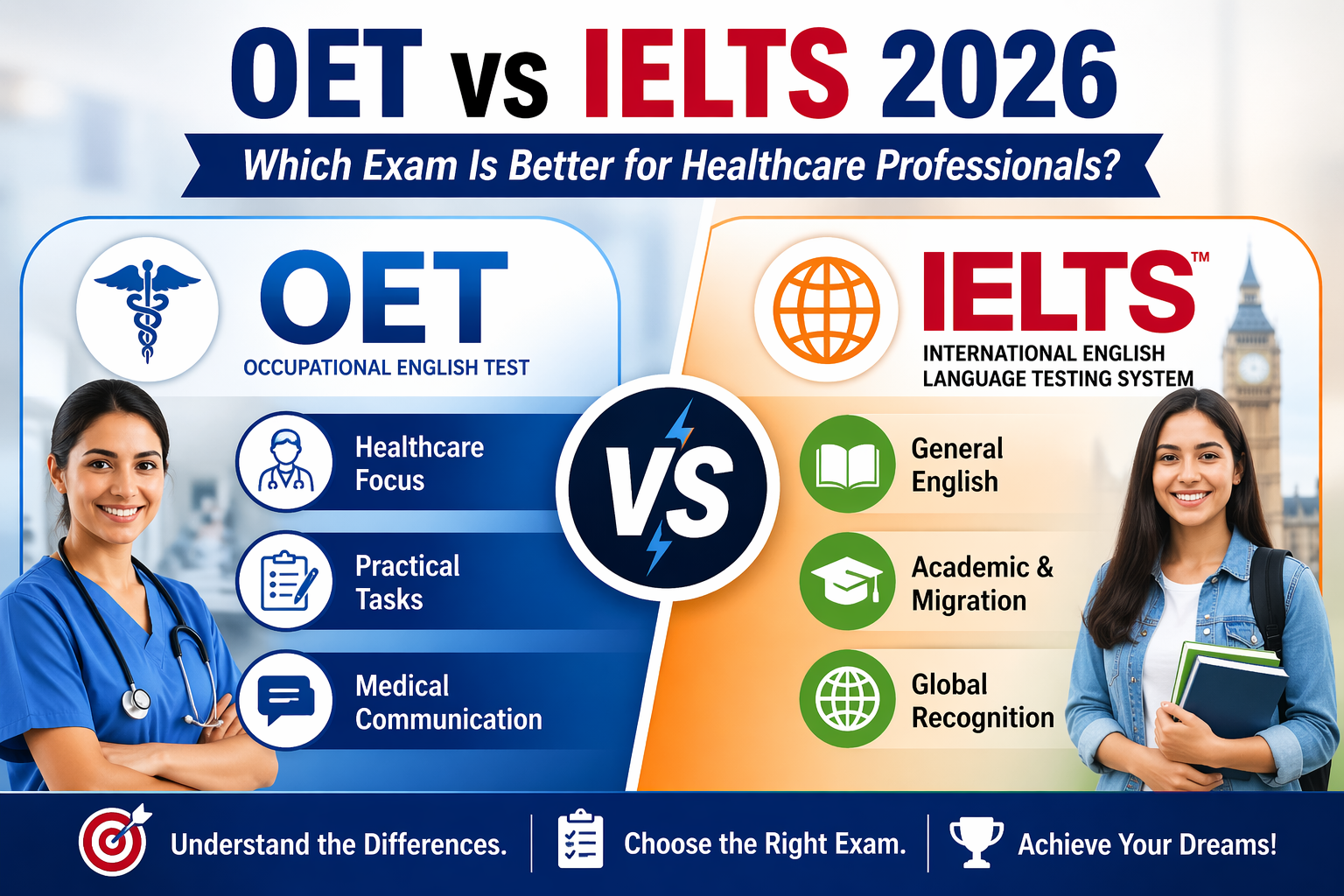
While both exams are widely accepted, they serve different purposes. On one hand, OET focuses on healthcare communication. On the other hand, IELTS evaluates general English skills used in academic and professional settings. As a result, your decision should depend on your career path.

Designed specifically for medical professionals, the **Occupational English Test emphasizes real-world communication in healthcare environments. By contrast, the **International English Language Testing System targets a broader audience across multiple industries. Consequently, selecting the right exam can save both time and effort.

This guide provides a complete comparison of OET vs IELTS 2026, covering format, difficulty, scoring, and expert recommendations.

🟦 OET vs IELTS Overview (Comparison)

To begin with, let’s compare both exams at a glance.

Feature OET IELTS
Focus Healthcare communication General English
Audience Healthcare professionals Students & professionals
Sections Listening, Reading, Writing, Speaking Listening, Reading, Writing, Speaking
Context Medical scenarios General topics

Although both exams share a similar structure, their content differs significantly. Therefore, choosing the right one depends on your background and long-term goals.

🟦 What Is OET in the OET vs IELTS Debate

The Occupational English Test evaluates English skills within healthcare environments. Rather than relying on general topics, it focuses on communication in real medical situations.

For example, candidates may listen to patient consultations, write referral letters, or participate in role-play scenarios. Because of this practical structure, the exam feels highly relevant to healthcare professionals.

Another advantage is the use of familiar medical terminology. This familiarity makes tasks easier to understand and complete. As a result, many candidates feel more confident when preparing for OET.

🟦 What Is IELTS in the OET vs IELTS Comparison?

The International English Language Testing System measures general English proficiency for study, work, and migration.

Unlike OET, the exam includes a wide variety of topics that are not tied to any specific profession. Consequently, candidates must adapt to different contexts, including academic discussions and everyday conversations.

Additionally, IELTS offers both Academic and General Training formats. Because of this flexibility, it remains suitable for a wide range of goals.

🟦 Key Differences Between OET vs IELTS

🟨 1. OET vs IELTS: Purpose of the Exam

A major difference lies in the purpose of each test. OET is designed specifically for healthcare professionals and focuses on workplace communication.

In contrast, IELTS serves a broader audience. Because of this, it evaluates general English skills required for education, employment, and migration.

🟨 2. OET vs IELTS: Exam Format

Although both exams include four sections, the nature of their content differs.

Healthcare-based scenarios appear in OET tasks, while IELTS presents general topics from various fields. Due to this distinction, OET often feels more practical for medical candidates. For a detailed breakdown of the test structure, refer to the official OET exam format page.

🟨 3. OET vs IELTS: Difficulty Level

Many candidates ask which exam is easier. The answer depends largely on your background.

Healthcare professionals often find OET more manageable because it uses familiar terminology and realistic situations. On the other hand, IELTS may seem more challenging due to its broader and sometimes abstract topics.

Even so, strong general English skills can make IELTS equally manageable.

🟨 4. OET vs IELTS: Scoring System

Different scoring methods also set these exams apart. OET uses a scale from 0 to 500, which converts into grades from A to E. In contrast, IELTS uses a band score system ranging from 0 to 9.

Most healthcare institutions require Grade B in OET or Band 7 in IELTS. Therefore, understanding these benchmarks helps you set clear goals.

🟨 5. OET vs IELTS: Acceptance Worldwide

Acceptance varies depending on purpose and profession. Healthcare boards and medical councils recognize OET.

Meanwhile, universities, employers, and immigration authorities worldwide accept IELTS. As a result, your career goals should guide your decision.

🟦 OET vs IELTS Section-Wise Comparison

🟨 Listening

Patient consultations and healthcare discussions form the basis of OET listening tasks. In contrast, IELTS includes general conversations and lectures.

Because of this difference, OET tends to feel more relevant for medical professionals.

🟨 Reading

Healthcare-related texts dominate OET reading tasks. Meanwhile, IELTS includes academic or general passages.

Consequently, medical candidates often find OET reading more familiar and easier to navigate.

🟨 Writing

Professional medical letters are required in OET writing tasks. By comparison, IELTS focuses on essays and reports.

As a result, OET writing aligns more closely with real workplace communication.

🟨 Speaking

Role-play scenarios are central to OET speaking tasks, simulating real healthcare interactions. In contrast, IELTS uses a structured interview format.

This difference makes OET more practical for workplace communication.

🟦 Which Exam Is Easier: OET or IELTS?

The level of difficulty depends on your experience and strengths.

Healthcare professionals generally find OET easier because it uses familiar language and real-life scenarios. However, IELTS may suit candidates who are comfortable with general English topics.

Ultimately, the easier exam is the one that matches your preparation style.

🟦 OET vs IELTS: Which Should You Choose?

🟨 Choose OET If:

If you decide to take OET, understanding the OET exam fees is an important step.

  • You are a healthcare professional
  • You prefer practical communication tasks
  • You want job-specific language skills

🟨 Choose IELTS If:

  • You are applying to universities
  • You need a general English test
  • You are not in the healthcare field

🟦 Pros and Cons of OET vs IELTS

🟨 Advantages of OET

OET offers several benefits for healthcare professionals.
First, the exam uses profession-specific content, which makes it easier to relate to real work situations.
In addition, candidates complete practical tasks that reflect everyday communication in healthcare settings.
Because of this structure, many medical professionals find OET easier to understand and apply.

🟨 Disadvantages of OET

Despite its advantages, OET has some limitations.
One key drawback is that it is restricted to healthcare fields, which reduces its flexibility.
Moreover, the exam fee is slightly higher compared to other English tests.
As a result, some candidates may consider alternative options.

🟨 Advantages of IELTS

IELTS provides a wide range of benefits for different types of candidates.
For example, it is accepted worldwide by universities, employers, and immigration authorities.
Additionally, the test suits all professions, not just healthcare.
Because of its flexibility, IELTS remains a popular choice globally.

🟨 Disadvantages of IELTS

However, IELTS also has certain drawbacks.
Unlike OET, it does not focus on healthcare-specific communication.
Furthermore, candidates must deal with abstract and unfamiliar topics.
Consequently, some healthcare professionals find it less relevant to their needs.

🟦 OET vs IELTS Tips for Choosing the Right Exam

Making the right decision requires careful evaluation.

Start by considering your career goals. Next, review the requirements of your target country or institution. In addition, assess your strengths and comfort level.

Finally, take a sample test for both exams. Comparing your performance will help you choose confidently.

🟦 FAQs: OET vs IELTS

❓ Is OET accepted everywhere IELTS is?

No, OET is mainly accepted in healthcare sectors.

❓ Which exam is cheaper?

IELTS is usually more affordable.

❓ Can I switch from IELTS to OET?

Yes, many candidates switch depending on their goals.

❓ Which exam is better for nurses?

OET is generally more suitable for nurses.

🟒 Conclusion

Choosing between OET vs IELTS depends on your goals and professional background. While IELTS offers broader opportunities, OET provides a specialized approach for healthcare professionals.

If your aim is to work in the medical field, OET is often the better choice. On the other hand, IELTS remains ideal for academic and general purposes.

In the end, selecting the right exam simplifies your preparation and increases your chances of success. Once you choose OET, the next step is to follow a structured preparation plan.

oet practice test 2026 free mock test sample questions listening reading writing speaking

OET Practice Test 2026: Free Sample Questions & Full Mock Test Guide

Preparing for the exam becomes much more effective when you regularly use an OET practice test. While theoretical study builds your foundation, applying that knowledge in a test format strengthens your performance. Therefore, practice tests play a crucial role in achieving a high score.

Unlike general English exams, OET focuses on healthcare communication. As a result, practice tests simulate real-life situations such as patient consultations and professional interactions. Consequently, candidates become more comfortable with the exam format.

The test is conducted by Occupational English Test and is widely accepted in countries like the UK, Australia, and New Zealand. Moreover, healthcare professionals prefer OET because it reflects real workplace scenarios.

In this guide, you will learn how to use OET practice tests effectively, explore sample questions, and apply proven strategies to score B or higher. Before starting practice, make sure you understand the exam structure.

🟦 What Is an OET Practice Test?

An OET practice test is a simulated version of the real exam. In other words, it mirrors the structure, timing, and difficulty level of the actual test.

More importantly, it helps you:

  • Experience real exam conditions
  • Identify strengths and weaknesses
  • Improve time management
  • Build confidence

Additionally, regular practice allows you to understand question patterns. As a result, you can approach the exam with greater confidence.

🟦 OET Practice Test Format (Based on Exam Pattern)

Before attempting mock tests, understanding the format is essential. Without this knowledge, even regular practice may not be effective.

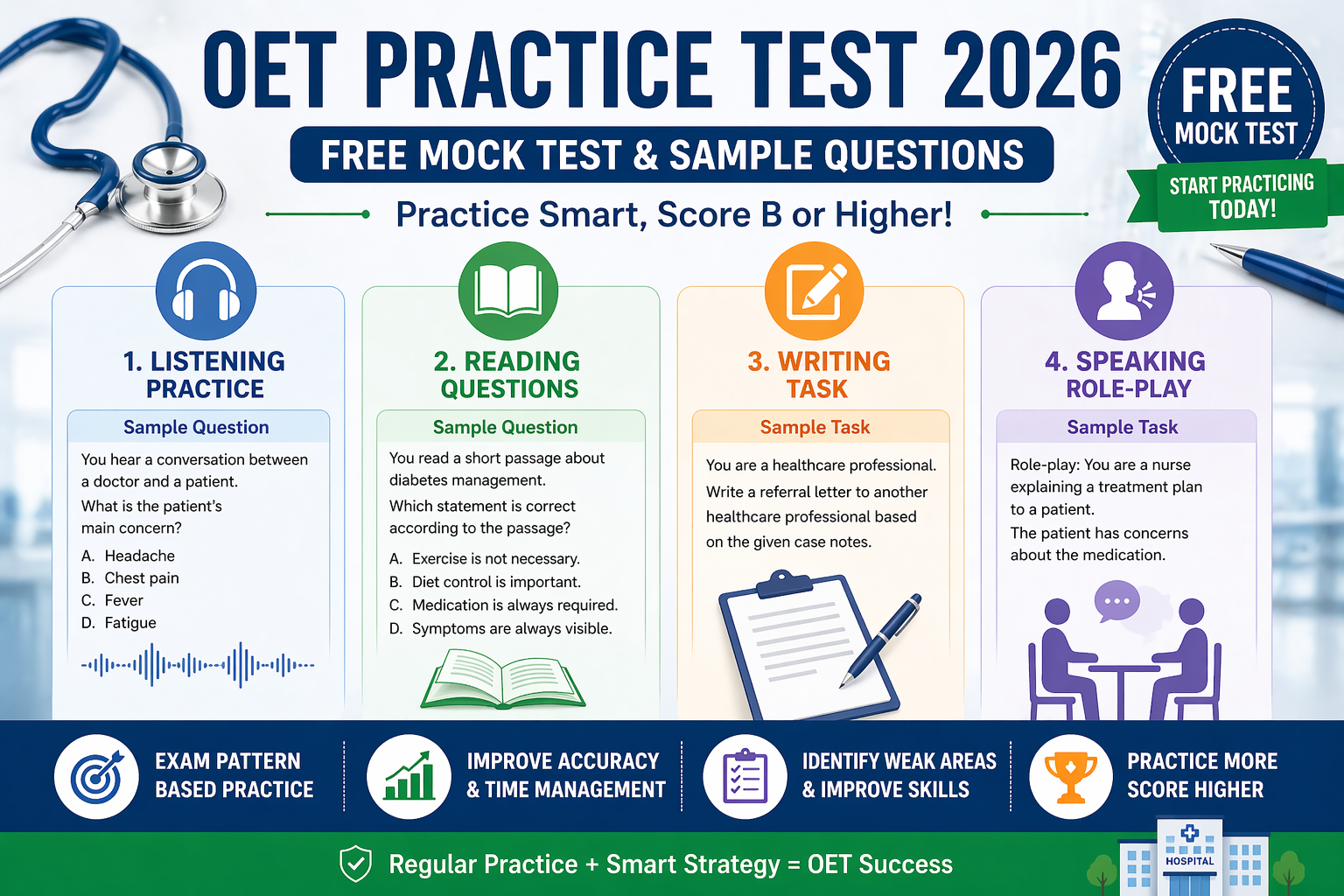
The OET exam includes four sections:

  • Listening
  • Reading
  • Writing
  • Speaking

Each section focuses on a specific communication skill. Therefore, your preparation should cover all areas equally. At the same time, you should adjust your focus based on your weaknesses. You can review the official exam format, section structure, and timing on the OET test information page.

🟦 Listening Practice Test (Sample)

🟨 Sample Task

You hear a conversation between a doctor and a patient discussing symptoms.

Question:
What is the patient’s main concern?

A. Headache
B. Chest pain
C. Fever
D. Fatigue

🟨 Strategy

First, listen for the main idea rather than every word. Then, identify keywords that indicate the patient’s primary issue. As a result, you can choose the correct answer more accurately.

🟦 Reading Practice Test (Sample)

🟨 Sample Task

You read a short medical passage about treatment methods.

Question:
Which statement is correct?

A. Exercise is unnecessary
B. Diet control is important
C. Medication is always required
D. Symptoms are always visible

🟨 Strategy

Begin by scanning the text for key points. Next, eliminate incorrect options systematically. Consequently, your accuracy improves while saving time.

🟦 Writing Practice Test (Sample)

🟨 Sample Task

Write a referral letter using the provided case notes.

🟨 Strategy

Start by organizing your ideas logically. Then, structure your response clearly with an introduction, body, and conclusion. Furthermore, maintain a professional tone throughout.

🟦 Speaking Practice Test (Sample)

🟨 Sample Task

Role-play: You are a nurse explaining treatment to a patient.

🟨 Strategy

Focus on clarity and empathy. In addition, use simple language so the patient understands easily. As a result, your communication becomes more effective.

🟦 Full-Length OET Mock Test Strategy

Taking full-length tests is essential. However, simply attempting them is not enough.

🟨 Step 1: Simulate Exam Conditions

First, choose a quiet environment. Then, follow the exact timing of the exam. This approach prepares you mentally.

🟨 Step 2: Avoid Interruptions

During the test, do not pause or take breaks. Instead, complete it in one sitting to replicate real conditions.

🟨 Step 3: Analyze Performance

After finishing, review your answers carefully. Moreover, identify patterns in your mistakes.

🟨 Step 4: Improve Weak Areas

Finally, focus on sections where your performance was weak. Consequently, your overall score improves.

🟦 How Many Practice Tests Should You Take?

The number of tests depends on your preparation level. However, consistency matters more than quantity.

  • Beginners: 3–5 tests
  • Intermediate: 5–8 tests
  • Advanced: 8–12 tests

At the same time, always review your tests thoroughly. Otherwise, you may repeat the same mistakes.

🟦 Benefits of OET Practice Tests

Practice tests offer several advantages. First, they improve time management. In addition, they increase accuracy. Furthermore, they build confidence under pressure.

Most importantly, they prepare you for real exam conditions. Therefore, skipping them can limit your performance.

🟦 Common Mistakes During Practice Tests

Many candidates make avoidable mistakes. For example, some skip reviewing their answers. Others take tests casually without proper timing.

In addition, ignoring weak areas can slow your progress. Therefore, every practice session should have a clear purpose.

🟦 Tips to Maximize OET Practice Test Results

🟨 Practice Consistently

Consistency is essential. Therefore, schedule regular practice sessions each week.

🟨 Review Every Test

After each test, analyze your mistakes carefully. As a result, you learn from errors.

🟨 Focus on Weak Sections

Spend extra time on areas that need improvement. Consequently, your overall performance becomes balanced.

🟨 Use Realistic Materials

Choose practice tests that closely match the real exam. This approach improves familiarity.

🟨 Track Your Progress

Keep a record of your scores. Over time, this helps you measure improvement.

🟦 Best Sources for OET Practice Tests

Using reliable resources is important. For instance, official materials provide the most accurate practice experience.

In addition, online platforms offer a variety of tests. However, always choose quality over quantity.

🟦 When Should You Start Taking Practice Tests?

Timing plays an important role in preparation. Therefore, follow a structured approach.

  • Week 1–2: Light practice
  • Week 3: Section-wise tests
  • Week 4: Full-length mock tests

This gradual approach ensures steady improvement. Moreover, it prevents burnout.

🟦 OET Practice Test FAQs

❓ Are practice tests free?

Some are free, while others require payment.

❓ How accurate are mock tests?

High-quality tests closely match the real exam.

❓ Can I pass without practice tests?

Although it is possible, practice tests significantly improve your chances.

❓ How often should I take tests?

Ideally, take 1–2 tests per week.

🟒 Conclusion

Using an OET practice test is one of the most effective ways to prepare. While studying concepts is important, applying them in real scenarios leads to better results.

By practicing consistently, reviewing mistakes, and focusing on weak areas, you can improve your score significantly. Ultimately, success depends on both strategy and effort. Following a structured preparation strategy can boost your mock test scores.

oet study plan 2026 4 week schedule preparation strategy healthcare english exam

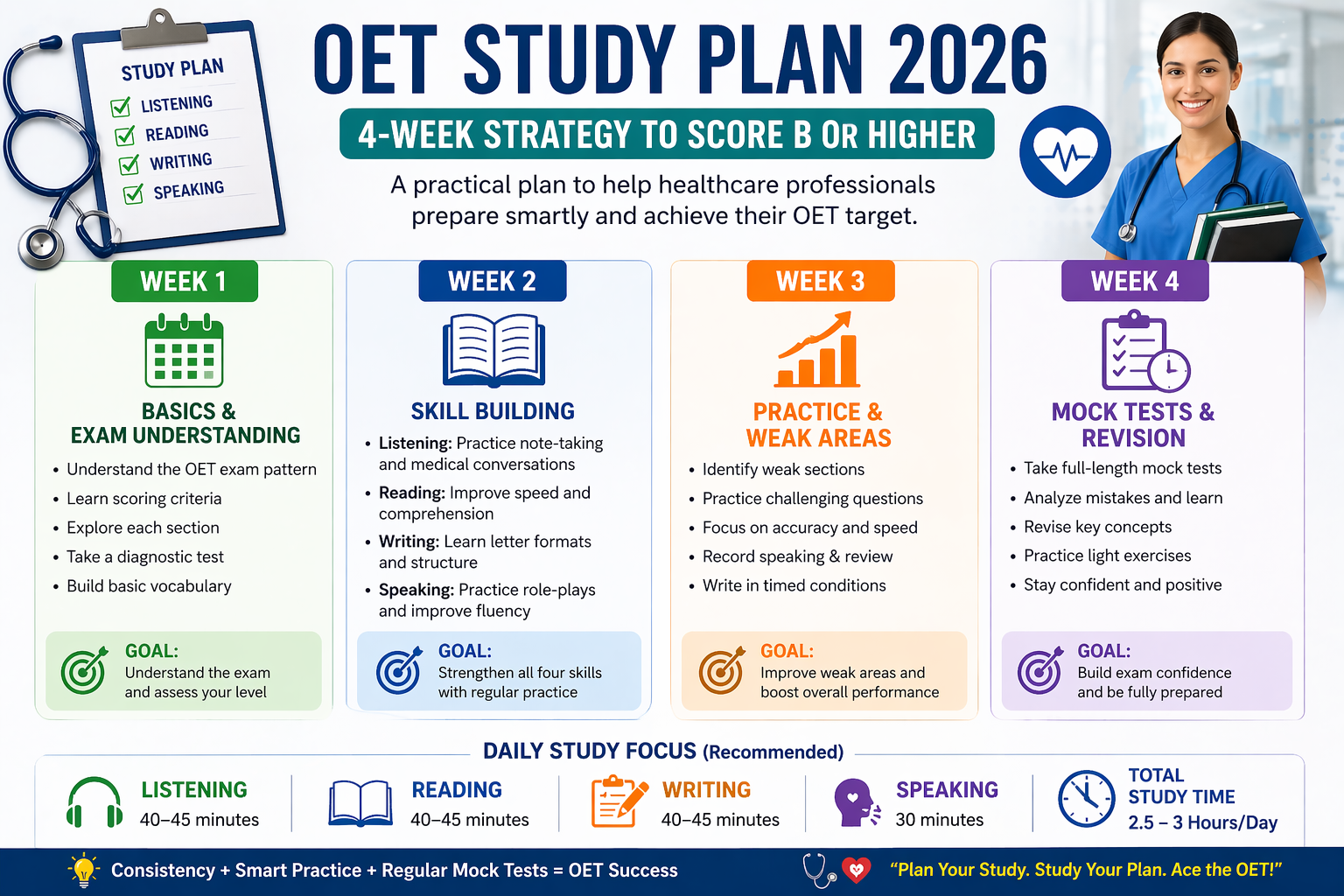
OET Study Plan 2026: 4-Week Strategy to Score B or Higher

Preparing for the OET exam requires more than just general English practice. Instead, candidates need a structured OET study plan that focuses on healthcare communication. Since the test evaluates real-life medical scenarios, your preparation must reflect practical usage rather than theory alone.

Without a clear plan, preparation often becomes inconsistent. As a result, many candidates spend too much time on certain sections while ignoring others. However, a balanced and strategic approach ensures steady progress across all skills.

The exam is conducted by Occupational English Test and is widely accepted in countries like the UK, Australia, and New Zealand. Therefore, scoring well can significantly improve your career opportunities.

In this guide, you will follow a complete OET study plan for 2026, including a 4-week schedule, daily routines, and expert strategies designed to help you achieve a B grade or higher. To build an effective strategy, you should first understand the exam format.

🟦 Why a Structured OET Study Plan Matters

A well-organized plan helps you stay focused throughout your preparation. More importantly, it ensures that every section receives equal attention. You can review the official exam format, sections, and structure on the OET test information page.

For example, some candidates focus heavily on reading while neglecting speaking. Consequently, their overall score suffers. On the other hand, a structured approach keeps your preparation balanced.

In addition, a study plan allows you to:

  • Track your progress effectively
  • Identify weak areas early
  • Improve time management
  • Build confidence gradually

🟦 Overview of the 4-Week OET Study Plan

To simplify your preparation, this plan divides your study schedule into four clear stages.

  • Week 1: Build understanding and basics
  • Week 2: Strengthen core skills
  • Week 3: Improve weak areas and accuracy
  • Week 4: Practice with mock tests and revise

By following this structure, you can progress step by step without feeling overwhelmed. Moreover, each stage prepares you for the next level.

🟦 Week 1: Build a Strong Foundation

During the first week, focus on understanding the exam pattern and basic requirements. Instead of jumping into advanced practice, start by building clarity.

🟨 Key Focus Areas

  • Learn the exam structure
  • Understand scoring criteria
  • Take an initial diagnostic test

🟨 Daily Plan

Day 1–2:
Begin by exploring each section of the exam. At this stage, avoid rushing into practice. Instead, focus on understanding formats and question types.

Day 3–4:
Next, start light practice for listening and reading. In addition, pay attention to how questions are framed.

Day 5–6:
Move on to writing and speaking tasks. At this point, analyze sample responses to understand expectations.

Day 7:
Finally, take a short mock test. This step helps you identify your starting level.

🟨 Weekly Goal

By the end of the week, you should feel comfortable with the exam format. More importantly, you should know your strengths and weaknesses.

🟦 Week 2: Strengthen Core Skills

Once you understand the basics, shift your focus to skill development. At this stage, consistent practice becomes essential.

🟨 Listening Strategy

Start practicing note-taking regularly. In addition, listen to medical conversations to improve comprehension. Over time, this approach helps you recognize key information quickly.

🟨 Reading Strategy

Focus on skimming and scanning techniques. Furthermore, practice under time pressure to improve speed. As a result, you will handle the reading section more efficiently.

🟨 Writing Strategy

Learn proper letter structures such as referral and discharge letters. Then, practice organizing your ideas clearly. Consequently, your responses will become more professional.

🟨 Speaking Strategy

Practice role-play scenarios daily. At the same time, work on fluency and clarity. This combination improves both confidence and performance.

🟨 Weekly Goal

By the end of this week, your core skills should show noticeable improvement. Additionally, you should feel more confident handling each section.

🟦 Week 3: Improve Weak Areas and Accuracy

At this stage, focus on refining your performance. Instead of practicing everything equally, concentrate on areas that need improvement.

🟨 Identify Weak Points

Review your previous test results carefully. For instance, if listening scores are low, dedicate extra time to that section.

🟨 Targeted Practice

Work on challenging question types. Moreover, practice under timed conditions to simulate the real exam. Regular practice using mock tests can significantly improve your performance.

🟨 Speaking Improvement

Record your responses and listen to them. This method helps you identify pronunciation and fluency issues. As a result, you can make quick improvements.

🟨 Writing Improvement

Practice writing tasks within the time limit. In addition, focus on clarity and structure rather than complexity.

🟨 Weekly Goal

By the end of week three, your weak areas should improve significantly. Consequently, your overall performance becomes more balanced.

🟦 Week 4: Mock Tests and Final Revision

The final week focuses on testing your preparation and building confidence.

🟨 Full-Length Mock Tests

Start taking complete mock tests under exam conditions. This approach helps you manage time effectively.

🟨 Analyze Performance

After each test, review your mistakes carefully. Then, focus on correcting them.

🟨 Final Revision

Instead of learning new topics, revise key concepts. In addition, practice light exercises to stay sharp.

🟨 Weekly Goal

By the end of this week, you should feel fully prepared and confident.

🟦 Daily Study Routine (Recommended)

A consistent routine improves results.

  • Listening: 40–45 minutes
  • Reading: 40–45 minutes
  • Writing: 40–45 minutes
  • Speaking: 30 minutes

Although the schedule seems simple, consistency matters more than duration.

🟦 OET Study Plan: Section-Wise Preparation Tips

🟨 OET Study Plan for Listening Section

Focus on understanding context instead of individual words. Additionally, practice note-taking regularly.

🟨 OET Study Plan for Reading Section

Work on speed and accuracy simultaneously. Furthermore, identify keywords quickly.

🟨 OET Study Plan for Writing Section

Use a clear structure and maintain a professional tone. At the same time, avoid unnecessary details.

🟨 OET Study Plan for Speaking Section

Speak clearly and confidently. Moreover, show empathy during role-plays.

🟦 Best Resources for OET Study Plan Preparation

Choosing the right resources can make a big difference.

  • Official OET materials
  • Practice tests
  • Online courses
  • Study groups

Using multiple resources ensures well-rounded preparation.

🟦 Common Mistakes in OET Study Plan

Many candidates make avoidable mistakes.

For example, ignoring time limits can reduce accuracy. Similarly, skipping speaking practice often leads to poor performance. In addition, writing overly complex answers reduces clarity.

Avoiding these mistakes can significantly improve your score.

🟦 Tips to Stay Consistent with Your OET Study Plan

Maintaining consistency is crucial.

First, set realistic daily goals. Then, track your progress regularly. Additionally, take short breaks to avoid burnout. As a result, you can stay motivated throughout your preparation.

🟦 OET Study Plan FAQs

❓ How many hours should I study daily?

Around 2–3 hours of focused study is sufficient.

❓ Is 4 weeks enough?

Yes, provided you follow a structured plan consistently.

❓ Can I prepare without coaching?

Yes, self-study works well with proper resources.

❓ How can I improve speaking?

Practice daily and use real-life scenarios.

🟒 Conclusion: Mastering the OET Study Plan

Following a structured OET study plan can significantly improve your chances of success. Instead of relying on random preparation, a clear strategy helps you stay focused and consistent.

By practicing regularly, improving weak areas, and taking mock tests, you can achieve a high score. Ultimately, success depends on discipline, smart planning, and consistent effort.

oet exam pattern 2026 listening reading writing speaking sections timing format healthcare test

OET Exam Pattern 2026: Section-Wise Format, Timing & Marking Explained

Preparing for the OET exam becomes much easier when you clearly understand its structure. Since this test targets healthcare professionals, it focuses on real-life communication scenarios rather than general English usage. Therefore, learning the OET exam pattern helps you approach the test with confidence.

Unlike traditional language exams, OET evaluates how effectively you communicate in clinical settings. As a result, each section reflects tasks you may face in hospitals, clinics, or healthcare environments. Consequently, candidates who understand the pattern early tend to perform better.

The exam is conducted by Occupational English Test and is widely accepted in countries like the UK, Australia, and New Zealand. Moreover, many healthcare boards require OET scores for licensing purposes.

In this guide, you will explore the complete OET exam pattern 2026, including section-wise format, timing, scoring system, and practical tips to improve your performance. Understanding the exam format also helps you estimate the OET exam fees involved.

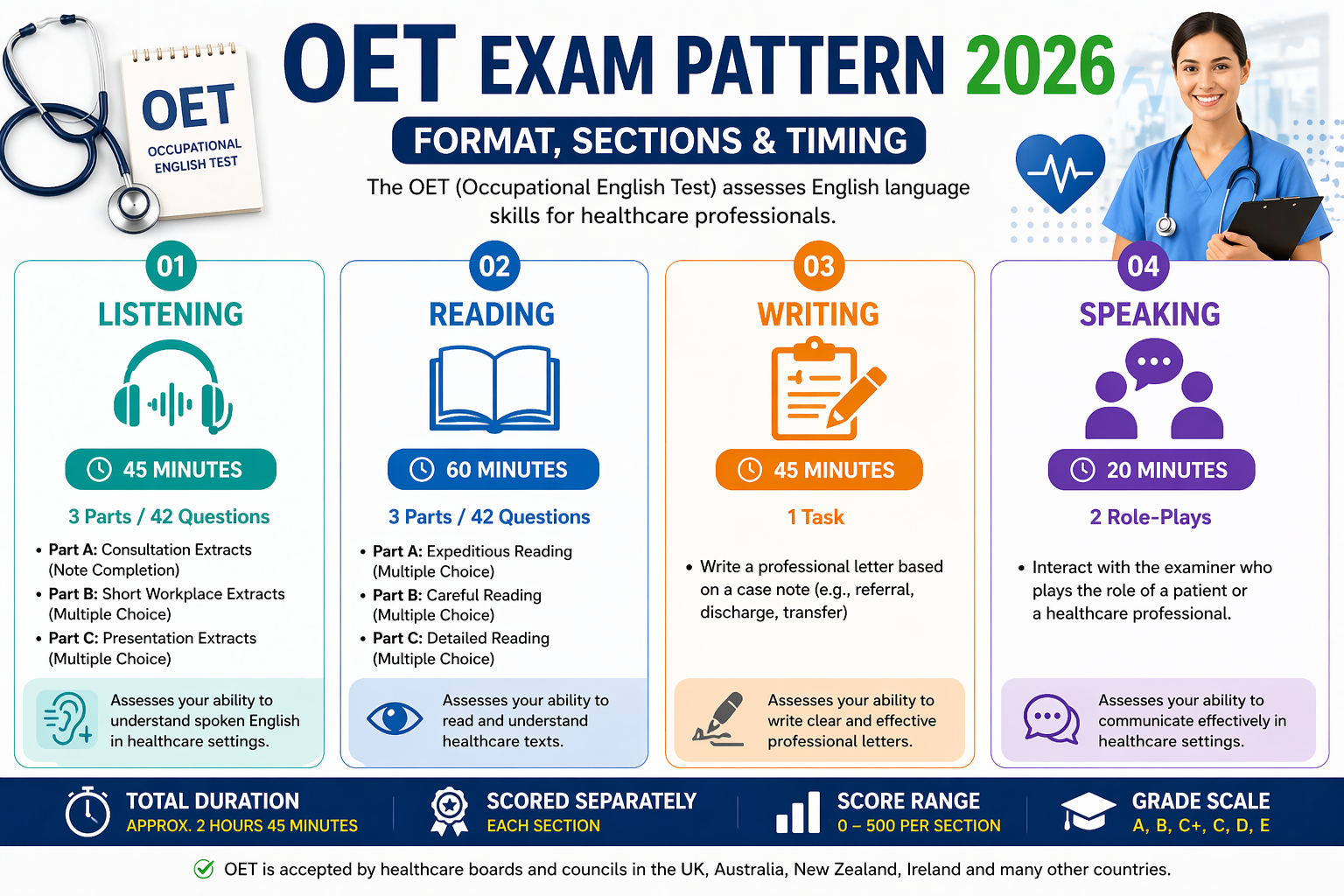
🟦 OET Exam Pattern 2026 Overview

To begin with, the OET exam consists of four main sections:

  • Listening
  • Reading
  • Writing
  • Speaking

Each section tests a different skill required in healthcare communication. In addition, the exam uses real-world scenarios, which makes it highly practical. You can explore the complete section-wise format and official structure on the OET test information page.

🟨 OET Exam Pattern Key Highlights

  • Total Duration: Approximately 2 hours 45 minutes
  • Mode: Paper-based and computer-based options
  • Focus: Healthcare-specific communication
  • Scoring: Each section scored separately

Because every section carries equal importance, balanced preparation becomes essential.

🟦 OET Exam Pattern: Listening Section Format

The listening section evaluates how well you understand spoken English in medical contexts. Therefore, active listening plays a key role.

🟨 OET Listening Section Duration and Structure

  • Around 45 minutes

🟨 Structure

The section includes three distinct parts:

Part A: Consultation Extracts
Here, you listen to conversations between a healthcare professional and a patient. At the same time, you complete notes based on what you hear.

Part B: Short Workplace Extracts
In this part, you listen to short workplace conversations. Afterward, you answer multiple-choice questions.

Part C: Presentation Extracts
Finally, you listen to longer discussions, such as lectures or interviews. Then, you answer detailed questions.

🟨 Skills Tested in OET Listening Section

  • Understanding conversations
  • Identifying key details
  • Interpreting professional discussions

🟨 OET Listening Preparation Tips

Instead of focusing on every word, try to understand the overall context. Additionally, practice note-taking regularly to improve accuracy.

🟦 OET Exam Pattern: Reading Section Format

The reading section measures your ability to process written healthcare information efficiently. Therefore, both speed and comprehension matter.

🟨 OET Reading Section Duration and Structure

  • 60 minutes

🟨 Structure

The reading section also includes three parts:

Part A: Expeditious Reading
First, you read multiple short texts. Then, you answer questions quickly under strict time pressure.

Part B: Careful Reading
Next, you read workplace-related texts. After that, you answer multiple-choice questions.

Part C: Detailed Reading
Finally, you read longer passages and answer in-depth comprehension questions.

🟨 Skills Tested

  • Skimming and scanning
  • Understanding key information
  • Analyzing detailed content

🟨 Preparation Tip

Practice reading under timed conditions. Furthermore, learn to identify keywords quickly.

🟦 OET Writing Section Pattern

The writing section focuses on professional communication in healthcare settings. Therefore, clarity and structure become essential.

🟨 Duration

  • 45 minutes

🟨 Structure

You complete one task based on case notes.

Typically, the task involves:

  • Referral letters
  • Discharge letters
  • Transfer letters

🟨 Skills Tested

  • Organizing ideas clearly
  • Using formal language
  • Communicating medical information effectively

🟨 Preparation Tip

First, plan your response before writing. Then, structure your answer logically. As a result, your writing becomes clearer and more effective.

🟦 OET Speaking Section Pattern

The speaking section evaluates how well you communicate verbally in healthcare situations. Therefore, confidence and clarity are crucial.

🟨 Duration

  • Around 20 minutes

🟨 Structure

This section includes two role-plays.

During the test:

  • You act as a healthcare professional
  • The examiner acts as a patient or colleague

🟨 Skills Tested

  • Fluency and pronunciation
  • Empathy and tone
  • Ability to handle real-life situations

🟨 Preparation Tip

Practice speaking regularly with real scenarios. In addition, focus on clarity rather than speed.

🟦 OET Exam Pattern Timing Summary

To help you plan better, here is a quick overview:

Section Duration
Listening 45 minutes
Reading 60 minutes
Writing 45 minutes
Speaking 20 minutes

Since timing is strict, managing your pace becomes critical.

🟦 OET Exam Pattern Scoring System Explained

Understanding the scoring system helps you set realistic goals.

Each section receives a score between 0 and 500. Then, scores are converted into grades.

🟨 OET Score Range and Grade System

  • A (450–500): Excellent
  • B (350–440): Good
  • C+ (300–340): Moderate
  • C (200–290): Basic
  • D/E: Below required level

Most healthcare boards require at least a B grade. Therefore, aiming for consistency across all sections is important.

🟦 OET Exam Pattern: Computer-Based vs Paper-Based Format

OET offers flexibility through two formats.

🟨 Computer-Based

  • Faster typing
  • Quicker results
  • Better for tech-savvy candidates

🟨 Paper-Based

  • Traditional format
  • Suitable for handwritten responses

Choosing the right format depends on your comfort level. For example, strong typing skills make the computer-based option more suitable.

🟦 Common Challenges in OET Exam Pattern

Despite preparation, many candidates face challenges.

For instance, time management often becomes a major issue. In addition, understanding different accents in listening can be difficult. Furthermore, structuring writing tasks correctly requires practice.

Speaking also creates anxiety for some candidates. However, regular practice can significantly reduce this stress.

🟦 Tips to Master OET Exam Pattern

🟨 Understand the Format Thoroughly

Before starting preparation, learn how each section works. This approach reduces confusion later.

🟨 Practice Consistently

Regular practice improves both accuracy and confidence. Therefore, create a daily study routine.

🟨 Focus on Weak Areas

Identify sections where you struggle. Then, dedicate extra time to improving them.

🟨 Use Real-Life Scenarios

Since OET reflects real healthcare situations, practicing similar scenarios improves performance.

🟨 Take Mock Tests

Mock tests simulate the real exam. As a result, they help you manage time and reduce stress. Practicing with real questions is essential to mastering each section.

🟦 Common Mistakes in OET Exam Pattern

Many candidates lose marks due to avoidable mistakes.

For example, some ignore time limits. Others write overly complex answers, which reduces clarity. In addition, skipping speaking practice often leads to poor performance.

Therefore, focusing on clarity, timing, and consistency can make a big difference.

🟦 OET Exam Pattern FAQs

❓ Is OET easier than IELTS?

It depends on your background. However, healthcare professionals often find OET more relevant.

❓ How many writing tasks are there?

You complete one writing task.

❓ Can I take OET on a computer?

Yes, both formats are available.

❓ What is the total exam duration?

The exam lasts approximately 2 hours and 45 minutes.

🟒 Conclusion: Mastering the OET Exam Pattern

Understanding the OET exam pattern gives you a strong advantage during preparation. Since the test focuses on real-life healthcare communication, mastering its structure helps you perform with confidence.

By practicing regularly, improving weak areas, and managing your time effectively, you can achieve a high score. Ultimately, the right strategy combined with consistent effort will bring you closer to your career goals.

oet exam fees 2026 cost breakdown country wise fees payment methods occupational english test

OET Exam Fees 2026: Cost, Payment Methods & Country-Wise Details

Understanding the OET exam fees is an essential first step for healthcare professionals planning to take the test. Since the Occupational English Test focuses specifically on medical communication, it offers a specialized pathway for doctors, nurses, and other healthcare workers aiming to work abroad. Therefore, knowing the exact cost helps you plan both your finances and preparation strategy effectively.

Unlike general English proficiency exams, OET evaluates language skills in a healthcare context. As a result, many candidates consider it a valuable investment for their careers. However, the exam fee can seem relatively high at first glance. For this reason, it becomes important to understand what you are paying for and how the fee structure works.

The test is administered by Occupational English Test and is widely accepted in countries such as the UK, Australia, New Zealand, and Ireland. In addition, many healthcare regulatory bodies recognize OET scores for licensing and registration. Consequently, thousands of candidates take the exam every year to advance their careers internationally.

In this comprehensive guide, you will learn everything about OET exam fees in 2026, including the total cost, country-wise variations, payment methods, refund rules, and practical tips to manage your expenses. Before booking your exam, it’s important to understand the test structure and format.

🟦 OET Exam Fees 2026 Overview

The OET exam fee remains standardized across most regions. However, slight differences may appear due to currency conversion and local taxes. Therefore, you should always check the final payable amount before booking.

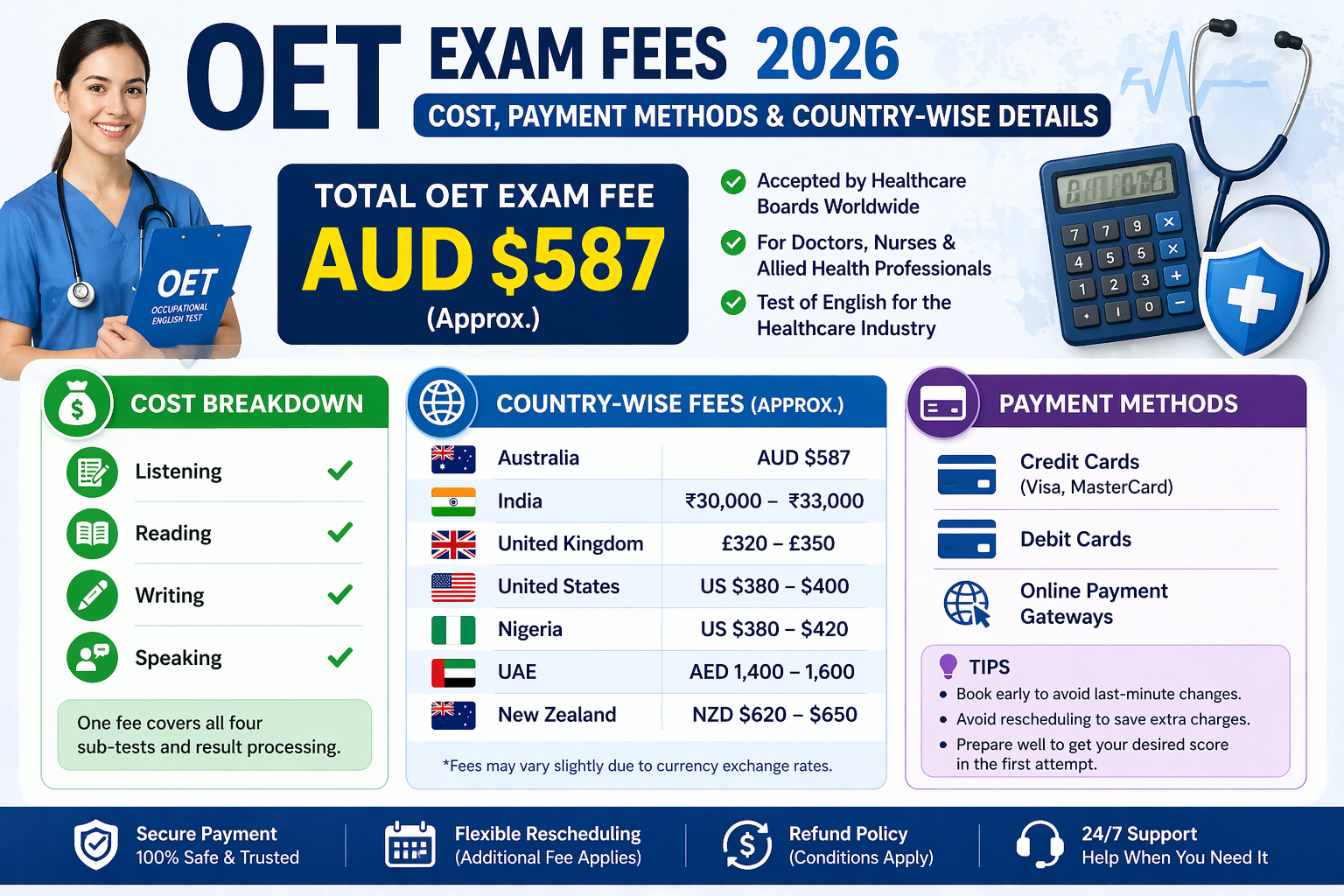
  • Full OET Test Fee: AUD $587
  • Approximate USD equivalent: $380–$400
  • Approximate INR equivalent: β‚Ή30,000–₹33,000
  • Approximate GBP equivalent: Β£320–£350

Since the fee is set in Australian dollars, exchange rates can influence how much you actually pay. As a result, candidates in different countries may see minor variations.

In addition, banks may charge extra fees for international transactions. Therefore, checking your bank’s conversion rates can help you avoid unexpected charges. You can check the latest fee updates and register directly through the official OET booking portal.

🟦 What Does the OET Fee Include?

The OET exam fee covers all four language skill components. Unlike some other tests, you do not need to pay separately for each section.

The fee includes:

  • Listening
  • Reading
  • Writing
  • Speaking

In addition, the fee covers administrative and processing services. For example, it includes:

  • Test center arrangements
  • Examiner evaluation
  • Online result access
  • Score reporting

Because of this all-inclusive structure, candidates receive a complete testing experience without hidden charges.

🟦 OET Exam Fees by Country

Although the base fee remains consistent, currency differences can affect the final cost. Therefore, reviewing country-specific estimates can help you plan better.

🟨 OET Fees in India

In India, the OET fee typically ranges between β‚Ή30,000 and β‚Ή33,000. Since many healthcare professionals migrate from India, the exam remains highly popular.

Moreover, test centers are available in major cities. As a result, candidates can easily access the exam without traveling far.

🟨 OET Fees in the United Kingdom

In the UK, candidates usually pay between Β£320 and Β£350. Because OET is widely accepted in the UK healthcare system, many international candidates take the test there.

In addition, the demand for healthcare professionals continues to grow. Therefore, OET remains a preferred choice.

🟨 OET Fees in Australia

Australia follows the official pricing of AUD $587. Since the test originates in Australia, the pricing remains stable and consistent.

🟨 OET Fees in Nigeria

In Nigeria, candidates pay approximately $380–$420 USD equivalent. However, exchange rate fluctuations can slightly change the final amount.

Therefore, checking the current conversion rate before payment is important.

🟨 OET Fees in Other Countries

In other regions such as the Middle East and Southeast Asia, the cost remains similar. However, local taxes and banking charges may apply.

As a result, candidates should verify the final amount during registration.

🟦 OET Payment Methods

OET offers multiple payment options to ensure convenience for candidates worldwide.

🟨 Accepted Payment Methods

Candidates can pay using:

  • Credit cards (Visa, MasterCard)
  • Debit cards
  • International payment gateways

Most candidates prefer card payments because they are fast and secure. In addition, online payments allow immediate confirmation of booking.

🟨 Payment Tips

To avoid issues during payment, follow these tips:

  • Ensure your card supports international transactions
  • Check your bank’s foreign transaction fees
  • Use a stable internet connection
  • Double-check payment details before confirming

By following these steps, you can complete your registration smoothly.

🟦 OET Refund Policy

Understanding the refund policy is crucial before booking your exam. Since the fee is relatively high, you should know your options in case of changes.

🟨 Cancellation Policy

Candidates can cancel their booking and receive a partial refund. However, the refund amount depends on how early you cancel.

For example:

  • Early cancellation β†’ Higher refund
  • Late cancellation β†’ Lower refund

🟨 No Refund Situations

If you cancel too close to the exam date, you may not receive any refund. Therefore, you should confirm your availability before booking.

🟦 OET Rescheduling Fees

Sometimes, candidates need to change their test date. OET allows rescheduling, but additional charges apply.

  • Early rescheduling β†’ Lower fee
  • Late rescheduling β†’ Higher fee

Because of this structure, it is better to plan your schedule carefully in advance.

🟦 Is OET Worth the Cost?

Many candidates wonder whether the OET exam fee justifies the cost.

Although OET is slightly more expensive than other English tests, it offers specialized content for healthcare professionals. As a result, candidates benefit from relevant scenarios and tasks.

Moreover, OET focuses on real-life medical communication. Therefore, it prepares candidates for actual workplace situations.

In the long run, many professionals consider it a worthwhile investment.

🟦 OET vs Other Exam Fees

Comparing OET with other exams helps you understand its value.

🟨 OET vs IELTS Fees

IELTS usually costs less than OET. However, IELTS focuses on general English rather than healthcare communication.

Therefore, candidates in the medical field often prefer OET despite the higher cost.

🟨 OET vs CELPIP Fees

CELPIP costs around CAD $280–$300, which is cheaper than OET. However, CELPIP mainly targets immigration rather than healthcare licensing.

As a result, OET remains the better option for healthcare professionals.

🟦 Hidden Costs to Consider

While the exam fee is the main expense, additional costs may arise.

These include:

  • Study materials
  • Coaching classes
  • Travel to test centers
  • Retake fees

Therefore, planning your budget in advance can help you avoid financial stress.

🟦 Tips to Save Money on OET Exam Fees

🟨 Book Early

Early booking helps you secure your preferred test date and avoid last-minute stress.

🟨 Avoid Rescheduling

Changing your test date increases costs. Therefore, choose your date carefully.

🟨 Prepare Thoroughly

Strong preparation reduces the chances of retaking the exam. As a result, you save money.

🟨 Use Free Resources

Many free study materials are available online. Therefore, you can reduce preparation costs.

🟦 Common Mistakes to Avoid

Candidates often make avoidable mistakes during registration.

For instance, some ignore currency conversion fees. As a result, they end up paying more than expected.

Others fail to check refund policies. Consequently, they lose money when plans change.

To avoid these issues, always review all details before payment.

🟦 OET Exam Fees FAQs

❓ Can I pay OET fees in installments?

No, you must pay the full fee at once.

❓ Is the OET fee refundable?

Yes, but only partially and depending on cancellation timing.

❓ Does OET offer discounts?

Occasionally, promotional offers may be available.

❓ What happens if I fail?

You must pay the full fee again to retake the exam.

❓ Are there extra charges after booking?

No hidden fees exist, but bank charges may apply.

🟒 Conclusion

The OET exam fees in 2026 remain consistent worldwide, with slight variations due to currency differences and local charges. Although the cost may appear high, it reflects the specialized nature of the test for healthcare professionals.

By understanding the fee structure, payment methods, refund policies, and additional costs, you can plan your exam more effectively. Ultimately, early preparation and careful planning will help you avoid unnecessary expenses and maximize your investment. Once you know the cost, the next step is to prepare effectively with a structured study plan.

celpip vs ielts 2026 comparison format scoring difficulty speaking and canada immigration test

CELPIP vs IELTS 2026: Which Test is Better for Canada?

Choosing between CELPIP vs IELTS can feel overwhelming, especially if you plan to study, work, or immigrate to Canada. Both exams assess your English language skills, but they differ in format, difficulty level, and overall experience. Therefore, selecting the right test plays a crucial role in your success.

CELPIP focuses specifically on Canadian English and real-life situations. In contrast, IELTS serves a global audience and includes a wider range of accents and formats. As a result, your personal strengths and long-term goals should guide your decision.

Paragon Testing Enterprises conducts the CELPIP exam, while British Council, IDP Education, and Cambridge Assessment English manage IELTS. In addition, Immigration, Refugees and Citizenship Canada (IRCC) accepts both exams for immigration and citizenship purposes.

In this detailed guide, you will explore every aspect of CELPIP vs IELTS, including format, scoring, difficulty, fees, advantages, and expert tips. By the end, you will clearly understand which test suits you best. If you choose CELPIP, start with this complete CELPIP exam guide to understand the structure.

🟦 CELPIP vs IELTS: Quick Comparison

Before diving deeper, let’s look at a quick comparison:

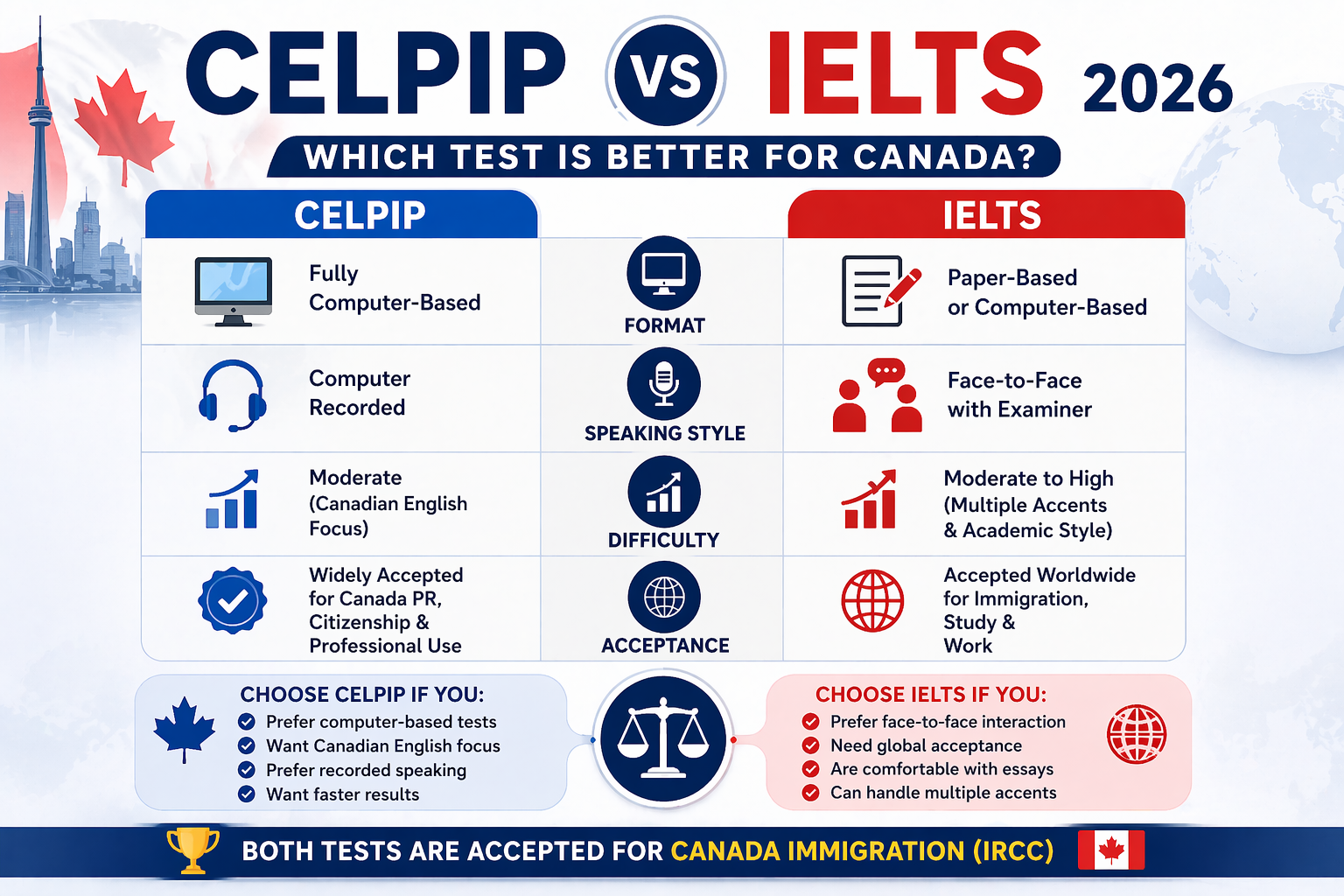
Feature CELPIP IELTS
Mode Fully computer-based Paper + Computer
Speaking Computer recorded Face-to-face
Duration ~3 hours ~2 hours 45 mins
Focus Canadian English Global English
Availability Limited countries Worldwide

Although both exams measure English proficiency effectively, they offer different experiences. Therefore, understanding these differences helps you make a smarter choice.

🟦 CELPIP vs IELTS: Exam Format Explained

Understanding the exam structure is essential before choosing a test. Each exam includes four sections, but the format differs significantly.

🟨 CELPIP Exam Format

CELPIP includes:

  • Listening
  • Reading
  • Writing
  • Speaking

You complete the entire exam in one sitting, which makes it more convenient for many candidates. Moreover, the computer-based format allows you to type answers directly, reducing handwriting issues.

In addition, the test focuses on real-life situations, such as emails and conversations. As a result, many candidates find it practical and easier to relate to.

🟨 IELTS Exam Format

IELTS also includes:

  • Listening
  • Reading
  • Writing
  • Speaking

However, the speaking test involves a face-to-face conversation with an examiner. Furthermore, you can choose between paper-based and computer-based formats.

Because of this flexibility, IELTS suits candidates with different preferences. At the same time, the human interaction in speaking may feel challenging for some.

🟦 CELPIP vs IELTS: Section-wise Comparison

A detailed section-wise comparison helps you understand the real differences.

🟨 Speaking Section

CELPIP records your responses through a computer. You speak into a microphone without interacting with a person. Therefore, this format suits candidates who feel nervous during face-to-face conversations.

On the other hand, IELTS requires direct interaction with an examiner. As a result, candidates who communicate confidently in person may perform better.

🟨 Listening Section

CELPIP uses mostly Canadian accents. Consequently, it feels more predictable and easier for many candidates.

In contrast, IELTS includes multiple accents, such as British and Australian. Therefore, it can feel more challenging if you are not familiar with different pronunciations.

🟨 Reading Section

CELPIP provides practical and straightforward reading passages. As a result, candidates often find it easier to understand.

IELTS includes academic and general passages. Therefore, it may require stronger reading skills and vocabulary.

🟨 Writing Section

CELPIP focuses on real-life tasks such as writing emails and survey responses. Because of this, candidates can relate more easily to the topics.

IELTS requires essay writing and formal responses. Consequently, it demands stronger structure and advanced vocabulary.

🟦 CELPIP vs IELTS: Scoring System

Understanding the scoring system helps you set realistic goals.

🟨 CELPIP Scoring

CELPIP uses a scale from 1 to 12 for each section. This system makes it easy to understand your performance level.

🟨 IELTS Scoring

IELTS uses band scores from 0 to 9. It also includes half-band scores such as 6.5 or 7.5.

🟨 Score Comparison

Both scoring systems differ, but institutions and immigration authorities accept them equally. Therefore, you should not choose a test based on scoring alone.

🟦 CELPIP vs IELTS: Difficulty Level

Many candidates ask which test is easier. However, the answer depends on your strengths.

CELPIP feels easier for candidates comfortable with computers and Canadian English. In addition, its predictable format makes preparation simpler.

IELTS, on the other hand, suits candidates who prefer face-to-face communication and traditional exams. However, the variety of accents and writing tasks can increase difficulty.

Ultimately, your personal skills determine which test feels easier. To prepare effectively, follow a structured CELPIP study plan.

🟦 CELPIP vs IELTS: Fees

Both exams cost a similar amount, although prices vary slightly by location.

  • CELPIP: Around $280–$300 CAD
  • IELTS: Around $250–$300 USD

Since the difference is minimal, cost should not be your main deciding factor.

🟦 CELPIP vs IELTS: Acceptance and Recognition

Acceptance plays a major role in your decision.

Immigration, Refugees and Citizenship Canada accepts both CELPIP and IELTS for immigration and citizenship.

However, IELTS has global recognition and is accepted in countries like the UK, Australia, and the USA. In contrast, CELPIP mainly serves Canada.

Therefore, if you plan to move beyond Canada, IELTS may offer more flexibility.

🟦 Advantages of CELPIP

CELPIP offers several benefits:

  • Fully computer-based format
  • Faster results
  • Simple and practical tasks
  • No face-to-face speaking

Because of these advantages, many candidates find it more comfortable.

🟦 Advantages of IELTS

IELTS also provides strong benefits:

  • Global acceptance
  • Flexible test formats
  • Face-to-face speaking interaction
  • Widely recognized by universities

As a result, it remains a popular choice worldwide.

🟦 When to Choose CELPIP

You should choose CELPIP if you:

  • Prefer typing over writing
  • Feel nervous during face-to-face speaking
  • Want a Canada-focused exam
  • Prefer practical, real-life questions

🟦 When to Choose IELTS

You should choose IELTS if you:

  • Prefer speaking with an examiner
  • Need global recognition
  • Feel comfortable with academic writing
  • Can handle multiple accents

🟦 Tips to Choose Between CELPIP vs IELTS

Making the right choice requires careful evaluation.

First, identify your strengths. For example, strong typing skills make CELPIP easier.

Next, consider your goals. If you plan to study abroad, IELTS may be more suitable.

Finally, try sample tests from both exams. As a result, you can experience the format before deciding.

🟦 Common Mistakes When Choosing

Many candidates make mistakes due to lack of research.

Some choose IELTS without understanding the speaking format. Others select CELPIP without practicing typing.

To avoid these mistakes, always test both formats before making a decision.

🟦 CELPIP vs IELTS FAQs

❓ Which test is easier?

The easier test depends on your skills and preferences.

❓ Is CELPIP accepted worldwide?

No, it is mainly accepted in Canada.

❓ Is IELTS better for immigration?

Both tests work for immigration, but IELTS offers wider recognition.

❓ Can I switch tests later?

Yes, but choosing early helps you prepare more effectively.

🟒 Conclusion

Choosing between CELPIP vs IELTS depends on your personal strengths, goals, and preferences. CELPIP offers a computer-based experience tailored for Canada, while IELTS provides global recognition and flexibility.

Both exams provide reliable results. Therefore, you should choose the test that aligns with your preparation style and future plans. Once you decide, improve your score with a CELPIP practice test.