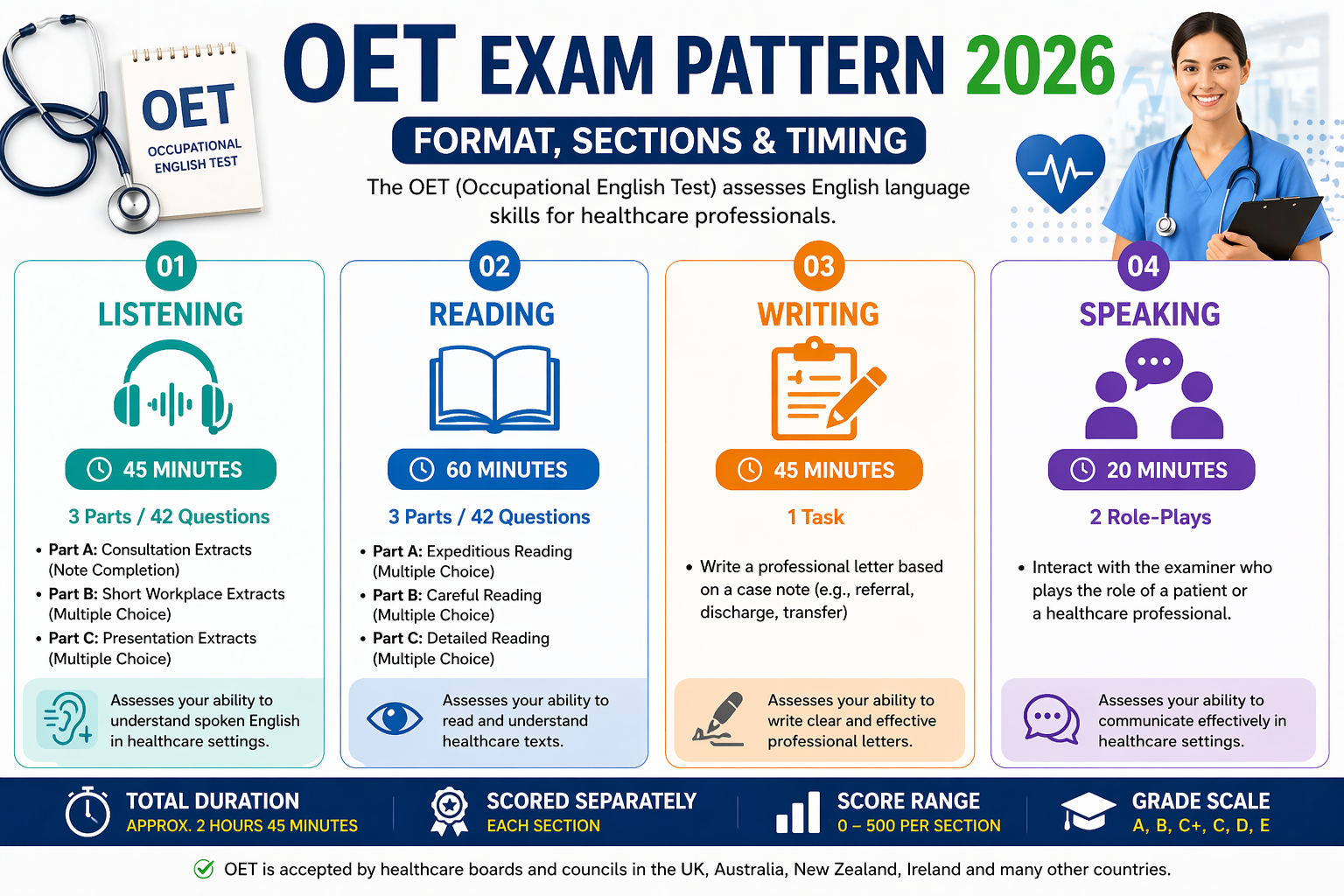
OET Exam Pattern 2026: Section-Wise Format, Timing & Marking Explained
Preparing for the OET exam becomes much easier when you clearly understand its structure. Since this test targets healthcare professionals, it focuses on real-life communication scenarios rather than general English usage. Therefore, learning the OET exam pattern helps you approach the test with confidence.
Unlike traditional language exams, OET evaluates how effectively you communicate in clinical settings. As a result, each section reflects tasks you may face in hospitals, clinics, or healthcare environments. Consequently, candidates who understand the pattern early tend to perform better.
The exam is conducted by Occupational English Test and is widely accepted in countries like the UK, Australia, and New Zealand. Moreover, many healthcare boards require OET scores for licensing purposes.
In this guide, you will explore the complete OET exam pattern 2026, including section-wise format, timing, scoring system, and practical tips to improve your performance. Understanding the exam format also helps you estimate the OET exam fees involved.
🟦 OET Exam Pattern 2026 Overview
To begin with, the OET exam consists of four main sections:
- Listening
- Reading
- Writing
- Speaking
Each section tests a different skill required in healthcare communication. In addition, the exam uses real-world scenarios, which makes it highly practical. You can explore the complete section-wise format and official structure on the OET test information page.
🟨 OET Exam Pattern Key Highlights
- Total Duration: Approximately 2 hours 45 minutes
- Mode: Paper-based and computer-based options
- Focus: Healthcare-specific communication
- Scoring: Each section scored separately
Because every section carries equal importance, balanced preparation becomes essential.
🟦 OET Exam Pattern: Listening Section Format
The listening section evaluates how well you understand spoken English in medical contexts. Therefore, active listening plays a key role.
🟨 OET Listening Section Duration and Structure
- Around 45 minutes
🟨 Structure
The section includes three distinct parts:
Part A: Consultation Extracts
Here, you listen to conversations between a healthcare professional and a patient. At the same time, you complete notes based on what you hear.
Part B: Short Workplace Extracts
In this part, you listen to short workplace conversations. Afterward, you answer multiple-choice questions.
Part C: Presentation Extracts
Finally, you listen to longer discussions, such as lectures or interviews. Then, you answer detailed questions.
🟨 Skills Tested in OET Listening Section
- Understanding conversations
- Identifying key details
- Interpreting professional discussions
🟨 OET Listening Preparation Tips
Instead of focusing on every word, try to understand the overall context. Additionally, practice note-taking regularly to improve accuracy.
🟦 OET Exam Pattern: Reading Section Format
The reading section measures your ability to process written healthcare information efficiently. Therefore, both speed and comprehension matter.
🟨 OET Reading Section Duration and Structure
- 60 minutes
🟨 Structure
The reading section also includes three parts:
Part A: Expeditious Reading
First, you read multiple short texts. Then, you answer questions quickly under strict time pressure.
Part B: Careful Reading
Next, you read workplace-related texts. After that, you answer multiple-choice questions.
Part C: Detailed Reading
Finally, you read longer passages and answer in-depth comprehension questions.
🟨 Skills Tested
- Skimming and scanning
- Understanding key information
- Analyzing detailed content
🟨 Preparation Tip
Practice reading under timed conditions. Furthermore, learn to identify keywords quickly.
🟦 OET Writing Section Pattern
The writing section focuses on professional communication in healthcare settings. Therefore, clarity and structure become essential.
🟨 Duration
- 45 minutes
🟨 Structure
You complete one task based on case notes.
Typically, the task involves:
- Referral letters
- Discharge letters
- Transfer letters
🟨 Skills Tested
- Organizing ideas clearly
- Using formal language
- Communicating medical information effectively
🟨 Preparation Tip
First, plan your response before writing. Then, structure your answer logically. As a result, your writing becomes clearer and more effective.
🟦 OET Speaking Section Pattern
The speaking section evaluates how well you communicate verbally in healthcare situations. Therefore, confidence and clarity are crucial.
🟨 Duration
- Around 20 minutes
🟨 Structure
This section includes two role-plays.
During the test:
- You act as a healthcare professional
- The examiner acts as a patient or colleague
🟨 Skills Tested
- Fluency and pronunciation
- Empathy and tone
- Ability to handle real-life situations
🟨 Preparation Tip
Practice speaking regularly with real scenarios. In addition, focus on clarity rather than speed.
🟦 OET Exam Pattern Timing Summary
To help you plan better, here is a quick overview:
| Section | Duration |
|---|---|
| Listening | 45 minutes |
| Reading | 60 minutes |
| Writing | 45 minutes |
| Speaking | 20 minutes |
Since timing is strict, managing your pace becomes critical.
🟦 OET Exam Pattern Scoring System Explained
Understanding the scoring system helps you set realistic goals.
Each section receives a score between 0 and 500. Then, scores are converted into grades.
🟨 OET Score Range and Grade System
- A (450–500): Excellent
- B (350–440): Good
- C+ (300–340): Moderate
- C (200–290): Basic
- D/E: Below required level
Most healthcare boards require at least a B grade. Therefore, aiming for consistency across all sections is important.
🟦 OET Exam Pattern: Computer-Based vs Paper-Based Format
OET offers flexibility through two formats.
🟨 Computer-Based
- Faster typing
- Quicker results
- Better for tech-savvy candidates
🟨 Paper-Based
- Traditional format
- Suitable for handwritten responses
Choosing the right format depends on your comfort level. For example, strong typing skills make the computer-based option more suitable.
🟦 Common Challenges in OET Exam Pattern
Despite preparation, many candidates face challenges.
For instance, time management often becomes a major issue. In addition, understanding different accents in listening can be difficult. Furthermore, structuring writing tasks correctly requires practice.
Speaking also creates anxiety for some candidates. However, regular practice can significantly reduce this stress.
🟦 Tips to Master OET Exam Pattern
🟨 Understand the Format Thoroughly
Before starting preparation, learn how each section works. This approach reduces confusion later.
🟨 Practice Consistently
Regular practice improves both accuracy and confidence. Therefore, create a daily study routine.
🟨 Focus on Weak Areas
Identify sections where you struggle. Then, dedicate extra time to improving them.
🟨 Use Real-Life Scenarios
Since OET reflects real healthcare situations, practicing similar scenarios improves performance.
🟨 Take Mock Tests
Mock tests simulate the real exam. As a result, they help you manage time and reduce stress. Practicing with real questions is essential to mastering each section.
🟦 Common Mistakes in OET Exam Pattern
Many candidates lose marks due to avoidable mistakes.
For example, some ignore time limits. Others write overly complex answers, which reduces clarity. In addition, skipping speaking practice often leads to poor performance.
Therefore, focusing on clarity, timing, and consistency can make a big difference.
🟦 OET Exam Pattern FAQs
❓ Is OET easier than IELTS?
It depends on your background. However, healthcare professionals often find OET more relevant.
❓ How many writing tasks are there?
You complete one writing task.
❓ Can I take OET on a computer?
Yes, both formats are available.
❓ What is the total exam duration?
The exam lasts approximately 2 hours and 45 minutes.
🟢 Conclusion: Mastering the OET Exam Pattern
Understanding the OET exam pattern gives you a strong advantage during preparation. Since the test focuses on real-life healthcare communication, mastering its structure helps you perform with confidence.
By practicing regularly, improving weak areas, and managing your time effectively, you can achieve a high score. Ultimately, the right strategy combined with consistent effort will bring you closer to your career goals.
Leave a Reply