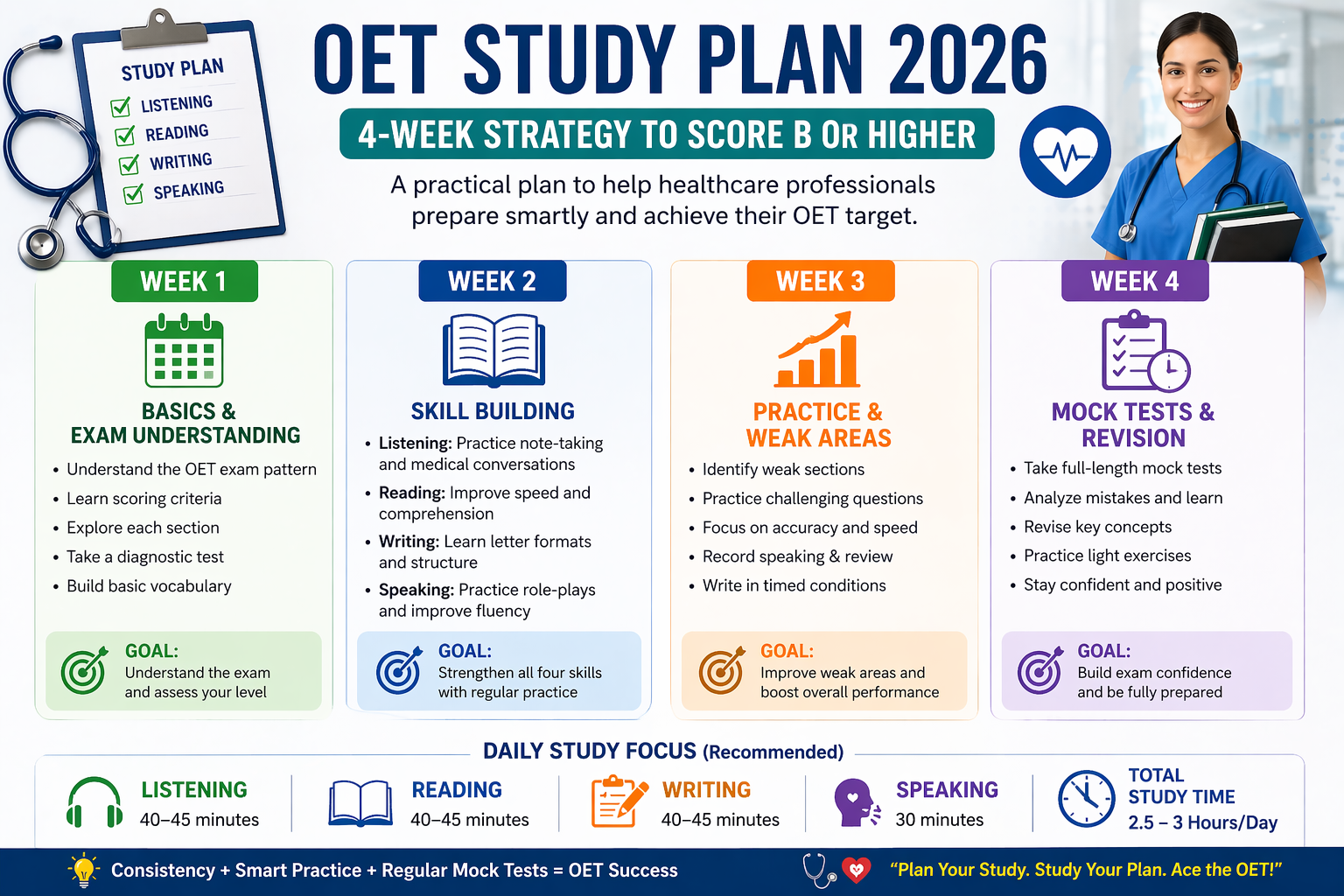
OET Study Plan 2026: 4-Week Strategy to Score B or Higher
Preparing for the OET exam requires more than just general English practice. Instead, candidates need a structured OET study plan that focuses on healthcare communication. Since the test evaluates real-life medical scenarios, your preparation must reflect practical usage rather than theory alone.
Without a clear plan, preparation often becomes inconsistent. As a result, many candidates spend too much time on certain sections while ignoring others. However, a balanced and strategic approach ensures steady progress across all skills.
The exam is conducted by Occupational English Test and is widely accepted in countries like the UK, Australia, and New Zealand. Therefore, scoring well can significantly improve your career opportunities.
In this guide, you will follow a complete OET study plan for 2026, including a 4-week schedule, daily routines, and expert strategies designed to help you achieve a B grade or higher. To build an effective strategy, you should first understand the exam format.
🟦 Why a Structured OET Study Plan Matters
A well-organized plan helps you stay focused throughout your preparation. More importantly, it ensures that every section receives equal attention. You can review the official exam format, sections, and structure on the OET test information page.
For example, some candidates focus heavily on reading while neglecting speaking. Consequently, their overall score suffers. On the other hand, a structured approach keeps your preparation balanced.
In addition, a study plan allows you to:
- Track your progress effectively
- Identify weak areas early
- Improve time management
- Build confidence gradually
🟦 Overview of the 4-Week OET Study Plan
To simplify your preparation, this plan divides your study schedule into four clear stages.
- Week 1: Build understanding and basics
- Week 2: Strengthen core skills
- Week 3: Improve weak areas and accuracy
- Week 4: Practice with mock tests and revise
By following this structure, you can progress step by step without feeling overwhelmed. Moreover, each stage prepares you for the next level.
🟦 Week 1: Build a Strong Foundation
During the first week, focus on understanding the exam pattern and basic requirements. Instead of jumping into advanced practice, start by building clarity.
🟨 Key Focus Areas
- Learn the exam structure
- Understand scoring criteria
- Take an initial diagnostic test
🟨 Daily Plan
Day 1–2:
Begin by exploring each section of the exam. At this stage, avoid rushing into practice. Instead, focus on understanding formats and question types.
Day 3–4:
Next, start light practice for listening and reading. In addition, pay attention to how questions are framed.
Day 5–6:
Move on to writing and speaking tasks. At this point, analyze sample responses to understand expectations.
Day 7:
Finally, take a short mock test. This step helps you identify your starting level.
🟨 Weekly Goal
By the end of the week, you should feel comfortable with the exam format. More importantly, you should know your strengths and weaknesses.
🟦 Week 2: Strengthen Core Skills
Once you understand the basics, shift your focus to skill development. At this stage, consistent practice becomes essential.
🟨 Listening Strategy
Start practicing note-taking regularly. In addition, listen to medical conversations to improve comprehension. Over time, this approach helps you recognize key information quickly.
🟨 Reading Strategy
Focus on skimming and scanning techniques. Furthermore, practice under time pressure to improve speed. As a result, you will handle the reading section more efficiently.
🟨 Writing Strategy
Learn proper letter structures such as referral and discharge letters. Then, practice organizing your ideas clearly. Consequently, your responses will become more professional.
🟨 Speaking Strategy
Practice role-play scenarios daily. At the same time, work on fluency and clarity. This combination improves both confidence and performance.
🟨 Weekly Goal
By the end of this week, your core skills should show noticeable improvement. Additionally, you should feel more confident handling each section.
🟦 Week 3: Improve Weak Areas and Accuracy
At this stage, focus on refining your performance. Instead of practicing everything equally, concentrate on areas that need improvement.
🟨 Identify Weak Points
Review your previous test results carefully. For instance, if listening scores are low, dedicate extra time to that section.
🟨 Targeted Practice
Work on challenging question types. Moreover, practice under timed conditions to simulate the real exam. Regular practice using mock tests can significantly improve your performance.
🟨 Speaking Improvement
Record your responses and listen to them. This method helps you identify pronunciation and fluency issues. As a result, you can make quick improvements.
🟨 Writing Improvement
Practice writing tasks within the time limit. In addition, focus on clarity and structure rather than complexity.
🟨 Weekly Goal
By the end of week three, your weak areas should improve significantly. Consequently, your overall performance becomes more balanced.
🟦 Week 4: Mock Tests and Final Revision
The final week focuses on testing your preparation and building confidence.
🟨 Full-Length Mock Tests
Start taking complete mock tests under exam conditions. This approach helps you manage time effectively.
🟨 Analyze Performance
After each test, review your mistakes carefully. Then, focus on correcting them.
🟨 Final Revision
Instead of learning new topics, revise key concepts. In addition, practice light exercises to stay sharp.
🟨 Weekly Goal
By the end of this week, you should feel fully prepared and confident.
🟦 Daily Study Routine (Recommended)
A consistent routine improves results.
- Listening: 40–45 minutes
- Reading: 40–45 minutes
- Writing: 40–45 minutes
- Speaking: 30 minutes
Although the schedule seems simple, consistency matters more than duration.
🟦 OET Study Plan: Section-Wise Preparation Tips
🟨 OET Study Plan for Listening Section
Focus on understanding context instead of individual words. Additionally, practice note-taking regularly.
🟨 OET Study Plan for Reading Section
Work on speed and accuracy simultaneously. Furthermore, identify keywords quickly.
🟨 OET Study Plan for Writing Section
Use a clear structure and maintain a professional tone. At the same time, avoid unnecessary details.
🟨 OET Study Plan for Speaking Section
Speak clearly and confidently. Moreover, show empathy during role-plays.
🟦 Best Resources for OET Study Plan Preparation
Choosing the right resources can make a big difference.
- Official OET materials
- Practice tests
- Online courses
- Study groups
Using multiple resources ensures well-rounded preparation.
🟦 Common Mistakes in OET Study Plan
Many candidates make avoidable mistakes.
For example, ignoring time limits can reduce accuracy. Similarly, skipping speaking practice often leads to poor performance. In addition, writing overly complex answers reduces clarity.
Avoiding these mistakes can significantly improve your score.
🟦 Tips to Stay Consistent with Your OET Study Plan
Maintaining consistency is crucial.
First, set realistic daily goals. Then, track your progress regularly. Additionally, take short breaks to avoid burnout. As a result, you can stay motivated throughout your preparation.
🟦 OET Study Plan FAQs
❓ How many hours should I study daily?
Around 2–3 hours of focused study is sufficient.
❓ Is 4 weeks enough?
Yes, provided you follow a structured plan consistently.
❓ Can I prepare without coaching?
Yes, self-study works well with proper resources.
❓ How can I improve speaking?
Practice daily and use real-life scenarios.
🟢 Conclusion: Mastering the OET Study Plan
Following a structured OET study plan can significantly improve your chances of success. Instead of relying on random preparation, a clear strategy helps you stay focused and consistent.
By practicing regularly, improving weak areas, and taking mock tests, you can achieve a high score. Ultimately, success depends on discipline, smart planning, and consistent effort.
Leave a Reply