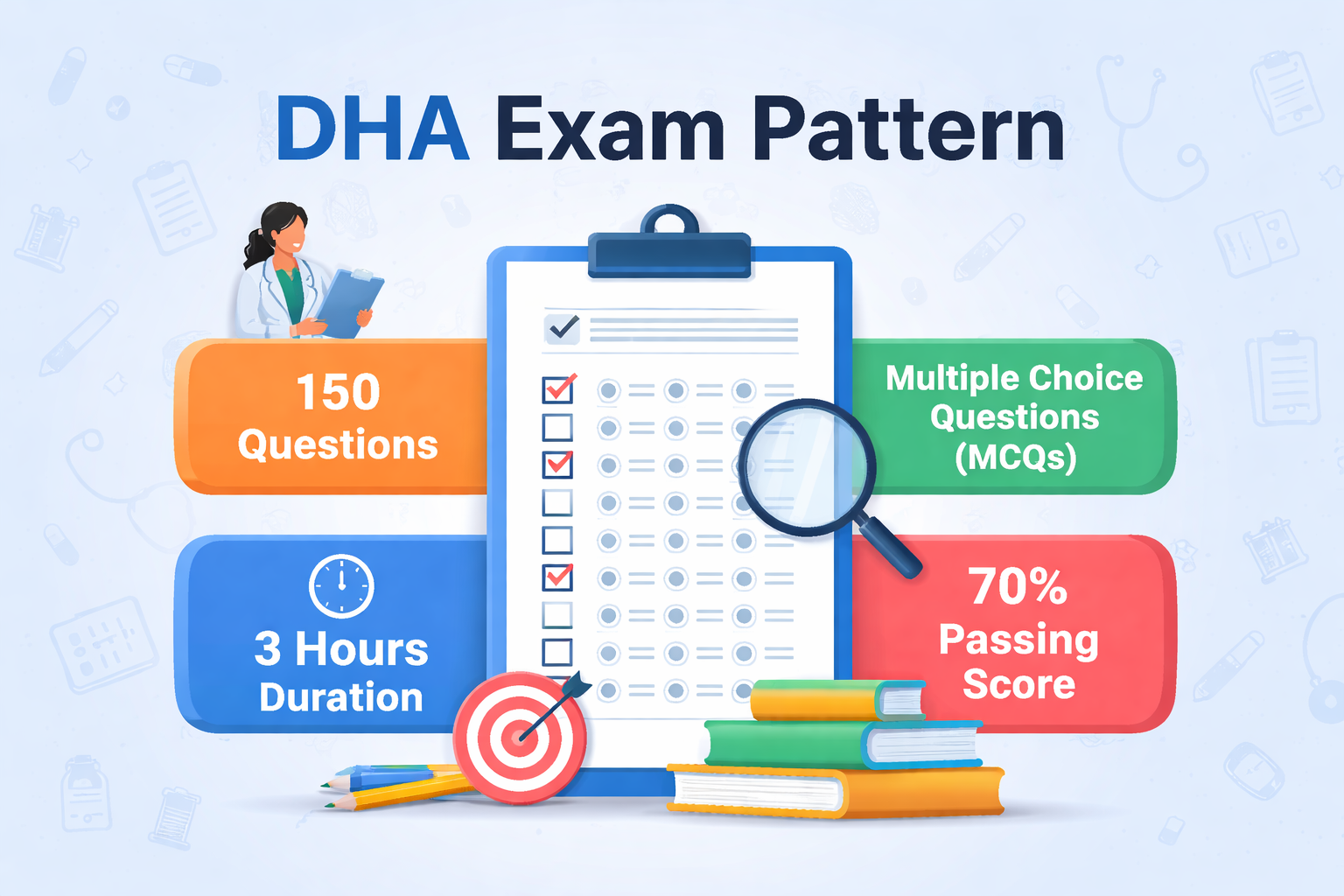
DHA Exam Pattern 2026: Complete Guide for Healthcare Professionals
Understanding the DHA exam pattern 2026 is the first critical step for healthcare professionals preparing to work in Dubai. Moreover, knowing the exam structure helps candidates plan their preparation efficiently, allocate study time to high-yield topics, and approach questions with confidence. In addition, understanding the pattern reduces exam anxiety because candidates know exactly what to expect on test day. Alongside the pattern, reviewing the DHA exam syllabus ensures you know what subjects to focus on.
This guide provides a comprehensive overview of the DHA exam pattern for doctors, nurses, pharmacists, and allied health professionals. Furthermore, it includes practical strategies, study tips, and common mistakes to avoid so that preparation is more effective and targeted. For the most accurate updates on the DHA exam format, visit the official DHA portal.
Overview of the DHA Exam Pattern 2026
The DHA licensing exam is designed to evaluate clinical knowledge, practical skills, and decision-making abilities. In addition, the exam follows a computer-based multiple-choice format, with no negative marking, and emphasizes case-based and scenario-based questions.
Therefore, understanding the structure is crucial for developing an effective study plan. Similarly, knowing how marks are distributed across subjects ensures candidates focus on the most important topics first. Moreover, practicing under timed conditions simulates the real exam environment and builds confidence. Ensure your degrees are verified through the Ministry of Education UAE before taking the DHA exam.
DHA Exam Pattern 2026 for Doctors
Doctors face a comprehensive exam covering pre-clinical, para-clinical, and clinical subjects. Consequently, preparation requires both in-depth knowledge and application of clinical reasoning.
1. Number of Questions and Duration
- Total Questions: 120–150 MCQs
- Duration: 2–3 hours depending on specialty
- Format: Computer-based
- Weightage: Clinical subjects 60–65%, para-clinical 20–25%, basic sciences 10–15%
In addition, the questions are mostly scenario-based to test practical decision-making. For example, a patient presenting with chest pain may require integrating physiology, pharmacology, and clinical knowledge to determine the next steps. Therefore, practicing case-based questions is essential for success.
2. Subject Distribution in the DHA Exam Pattern for Doctors
- Pre-Clinical: Anatomy, Physiology, Biochemistry
- Para-Clinical: Pathology, Microbiology, Pharmacology, Forensic Medicine, Community Medicine
- Clinical: Medicine, Surgery, Pediatrics, Obstetrics & Gynecology, Psychiatry, Dermatology, Ophthalmology, ENT, Orthopedics
Similarly, clinical questions assess applied knowledge and critical thinking. In addition, para-clinical and pre-clinical topics support clinical reasoning and often appear integrated into scenario-based questions.
3. Marking Scheme in DHA Exam Pattern 2026 for Doctors
- 1 mark per question
- No negative marking
- Passing requires 50–60% correct answers depending on specialty
Consequently, accuracy is more important than guesswork, and time management is key. Moreover, doctors should simulate full-length exams to build pacing skills.
DHA Exam Pattern for Nurses
Nurses focus on patient care, professional practice, and clinical judgment. In addition, the pattern emphasizes real-life patient scenarios rather than purely theoretical questions.
1. Number of Questions and Duration
- Total Questions: 90–120 MCQs
- Duration: 2–2.5 hours
- Format: Computer-based
Meanwhile, scenario-based questions dominate the exam, testing nurses’ ability to prioritize patient care effectively. Similarly, ethical and communication skills are frequently assessed.
2. Subject Breakdown for Nurses in DHA Exam Pattern 2026
- Professional Nursing Concepts: 20–25%
- Clinical Nursing Areas: 50–55%
- Critical Care & Emergency Nursing: 20–25%
For example, a question may require prioritizing interventions for multiple patients in a ward setting. Therefore, focusing on case-based practice is essential.
3. Marking Scheme
- 1 mark per question
- No negative marking
- Passing requires at least 50% correct answers
Consequently, practicing under timed conditions improves speed and decision-making. In addition, reviewing common nursing procedures enhances confidence.
DHA Exam Pattern for Pharmacists
Pharmacists’ exams test drug knowledge, clinical pharmacy skills, and regulatory understanding. Therefore, preparation should include both scientific knowledge and application in patient care scenarios.
1. Number of Questions and Duration
- Total Questions: 80–100 MCQs
- Duration: 2–2.5 hours
In addition, scenario-based questions require pharmacists to evaluate drug interactions, dosing, and patient counseling decisions.
2. Subject Distribution
- Pharmaceutical Sciences: 30–35%
- Clinical Pharmacy: 40–45%
- Pharmacy Practice & Regulations: 20–25%
Similarly, understanding UAE pharmacy laws and regulations is critical. Moreover, pharmacists should practice applying theoretical knowledge to realistic patient scenarios.
3. Marking Scheme
- 1 mark per question
- No negative marking
- Passing requires 50% correct answers
Consequently, combining practice questions with review of regulations ensures both theoretical and practical readiness.
DHA Exam Pattern for Allied Health Professionals
Allied health exams (physiotherapy, radiography, lab sciences) focus on applied clinical knowledge and decision-making. In addition, scenario-based MCQs are used to evaluate real-world competence.
1. Number of Questions and Duration
- Total Questions: 70–100 MCQs
- Duration: 2–2.5 hours
2. Subject Distribution
- Professional Knowledge: 30–40%
- Clinical Applications: 40–50%
- Case-Based Scenarios: 10–20%
For example, a physiotherapy candidate may need to design a rehabilitation plan for a post-stroke patient. Similarly, radiography candidates might interpret imaging scenarios for correct diagnostic outcomes.
3. Marking Scheme
- 1 mark per question
- No negative marking
- Passing requires 50% correct answers
In addition, focusing on applied knowledge and practicing cases is critical for success. Consequently, candidates should use multiple resources for thorough preparation.
Key Features Across All DHA Exams
- MCQ-Based Format – Most questions are multiple-choice.
- Scenario-Based Questions – Realistic patient or clinical scenarios dominate.
- No Negative Marking – Encourages educated guessing.
- Time-Limited – Each section requires efficient pacing.
- Focus on Practical Application – Exams emphasize decision-making over memorization.
Therefore, candidates should focus on comprehension and application. In addition, repeated practice under timed conditions strengthens exam readiness.
Tips to Prepare According to the DHA Exam Pattern
- Prioritize High-Weight Topics – Allocate study time based on subject weightage.
- Practice Case-Based MCQs – They dominate the exam and improve decision-making.
- Simulate Exam Conditions – Take timed full-length tests to manage pacing and stress.
- Identify Weak Areas – Focus revisions where performance is low.
- Use Multiple Resources – Combine books, online practice, and review guides for comprehensive preparation.
Moreover, frequent self-assessment improves retention and reduces errors. Similarly, tracking progress ensures all topics are reviewed. Alternatively, OET scores can fulfill the English proficiency requirement for the DHA exam. Use our recommended DHA exam books to practice questions that match the exam format. Also, verify your DHA exam eligibility before scheduling your test.
Sample Question Approaches
- Doctors: Identify differential diagnoses and next steps.
- Nurses: Prioritize patient care interventions.
- Pharmacists: Detect drug interactions and suggest adjustments.
- Allied Health: Develop treatment or rehabilitation plans based on patient scenarios.
In addition, practicing such scenarios mimics exam conditions and builds confidence. Consequently, candidates are better prepared for the real exam.
Common Mistakes in DHA Exam Pattern 2026 Preparation
- Ignoring high-weight topics
- Skipping scenario-based questions
- Failing to time practice tests
- Over-relying on a single study resource
Therefore, a structured plan that aligns with the exam pattern is essential. Similarly, integrating multiple sources ensures coverage of all exam topics.
Conclusion
Understanding the DHA exam pattern 2026 is essential for passing the licensing exam. By knowing the number of questions, duration, subject weightage, and types of questions, candidates can plan preparation efficiently.
Moreover, practicing scenario-based questions, focusing on high-weight topics, and simulating exam conditions maximizes readiness. In addition, following a structured study plan builds confidence and improves overall performance on exam day.