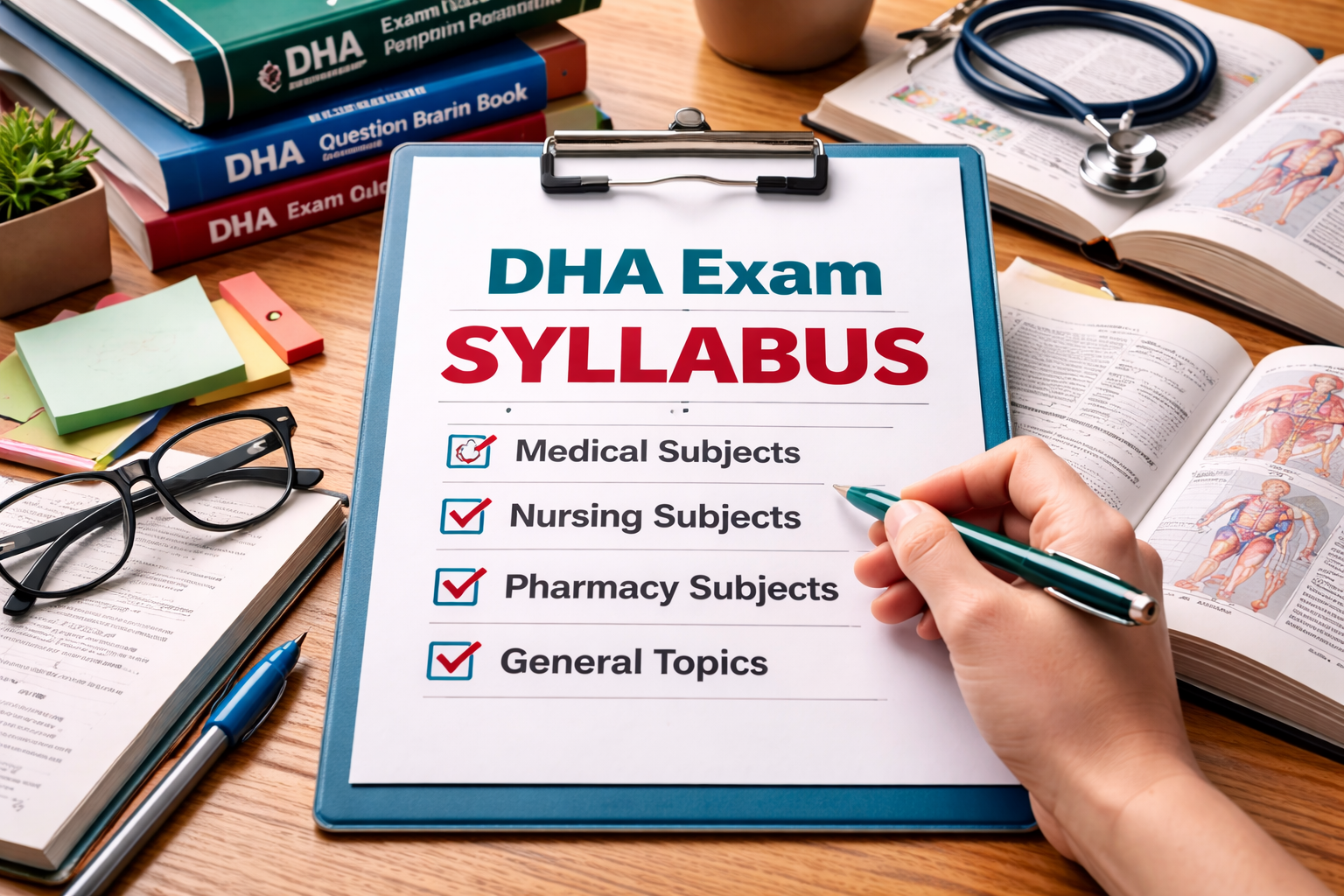
DHA Exam Syllabus 2026: Complete Guide for Healthcare Professionals
Preparing for the Dubai Health Authority (DHA) exam can be challenging; however, having a clear understanding of the syllabus makes preparation much more efficient. The DHA exam syllabus 2026 outlines all the topics that healthcare professionals — including doctors, nurses, pharmacists, and allied health specialists must study to succeed. Moreover, knowing the syllabus allows you to design a smart study plan, prioritize high-yield areas, and monitor your progress systematically. For the most accurate updates on topics and exam structure, visit the official DHA portal
In addition, focusing on the syllabus ensures that your study time is productive and directed toward topics that matter most for exam performance. Similarly, it helps reduce stress and increases confidence as exam day approaches. Once you understand the topics, it’s also important to know the DHA exam pattern to see how these subjects are tested.
Overview: What is the DHA Exam Syllabus?
The DHA exam syllabus is essentially a detailed roadmap of topics covered in the licensing examinations administered by the Dubai Health Authority. It evaluates clinical knowledge, practical application, and adherence to professional standards. In addition, the syllabus differs slightly depending on your profession, yet all candidates must demonstrate competence in clinical reasoning, ethical practice, and evidence-based decision-making.
Therefore, understanding the syllabus is the first critical step in effective exam preparation. Furthermore, it helps candidates identify which areas require more attention and which areas are already strong.
DHA Exam Syllabus for Doctors
The doctor’s DHA exam syllabus is broad, covering all areas relevant to safe clinical practice. Consequently, candidates need to study both core clinical subjects and supporting sciences thoroughly.
1. Basic Medical Sciences (Pre-Clinical)
- Anatomy
- Physiology
- Biochemistry
These topics form the foundation of clinical reasoning. In addition, they allow doctors to understand disease mechanisms and patient presentations. For example, physiology questions often appear in the form of clinical scenarios rather than isolated facts. Ensure your medical or nursing degrees are verified through the Ministry of Education UAE before starting your DHA syllabus preparation.
2. Para-Clinical Subjects
- Pathology
- Microbiology
- Pharmacology
- Forensic Medicine
- Community Medicine
Para-clinical subjects bridge basic sciences with clinical practice. Moreover, questions in this section are frequently case-based to test your ability to interpret lab results, microbial diagnoses, and pharmacotherapy applications. Similarly, understanding para-clinical concepts supports better clinical decision-making.
3. Clinical Subjects
- Medicine
- Surgery
- Pediatrics
- Obstetrics & Gynecology
- Psychiatry
- Dermatology
- Ophthalmology
- ENT
- Orthopedics
Clinical subjects dominate the DHA syllabus for doctors. Therefore, candidates should prioritize these topics early in preparation. In addition, clinical questions focus on diagnosis, investigations, and management plans, emphasizing applied knowledge rather than rote memorization.
DHA Exam Syllabus for Nurses
Nurses focus on holistic patient care, professional standards, and clinical competencies. In addition, they must demonstrate the ability to apply knowledge in practical settings.
1. Professional Nursing Concepts
- Nursing fundamentals
- Ethics and legal issues
- Communication skills
Moreover, ethical and legal topics are frequently tested, so nurses must be familiar with professional codes and responsibilities. Similarly, effective communication is a key skill evaluated in the exam.
2. Clinical Nursing Areas
- Medical-Surgical Nursing
- Pediatric Nursing
- Obstetrics & Gynecologic Nursing
- Psychiatric Nursing
- Community Health Nursing
These areas assess nurses’ ability to care for patients across various age groups and healthcare settings. For example, nurses should know assessment techniques, nursing diagnoses, interventions, and patient education strategies.
3. Critical Care & Emergency Nursing
- ICU protocols
- Emergency procedures
- Case management
In addition, critical care sections often present scenario-based questions that require rapid clinical judgment. Consequently, practicing case scenarios improves exam readiness and confidence.
DHA Exam Syllabus for Pharmacists
Pharmacists must master topics bridging pharmacological knowledge and clinical application. Therefore, understanding the syllabus in detail is essential.
1. Pharmaceutical Sciences
- Pharmacology
- Pharmaceutics
- Medicinal Chemistry
These subjects cover drug mechanisms, kinetics, and formulation science. Moreover, they form the foundation for clinical decision-making. In addition, understanding drug interactions and mechanisms is critical for patient safety.
2. Clinical Pharmacy
- Drug therapy management
- Patient counseling
- Adverse drug reactions
Similarly, pharmacists must demonstrate competence in supporting safe medication use and providing accurate guidance on therapeutic choices. Consequently, these topics are emphasized in the exam.
3. Pharmacy Practice & Regulations
- Legal and ethical aspects of pharmacy
- UAE pharmacy laws
- Dispensing standards
In addition, familiarizing yourself with local pharmacy regulations ensures compliance with professional standards and improves exam performance. Furthermore, knowledge of regulations is tested regularly.
DHA Exam Syllabus for Allied Health Professionals
Allied health professions (physiotherapy, radiography, lab sciences) have specialized syllabi. For example:
- Physiotherapy: Musculoskeletal, neurology, cardiorespiratory care
- Radiography: Radiation safety, imaging techniques
- Medical Lab Science: Hematology, microbiology, immunology
Therefore, candidates should study according to their specific profession. In addition, case-based MCQs often assess applied knowledge in real-life clinical scenarios. Similarly, reviewing practical applications alongside theory improves performance.
Core Themes Across All DHA Syllabi
- Clinical knowledge centered on practice standards
- Evidence-based decision-making
- Patient safety, ethics, and professional conduct
- Case-based questions rather than simple recall
- Application of knowledge in real clinical scenarios
Consequently, candidates should focus on deep understanding rather than memorization. In addition, integrating practice questions into study routines enhances retention and exam readiness.
Tips to Study the DHA Exam Syllabus Effectively
- Break Down the Syllabus by Weeks or Months
- Create a timetable for each section. Moreover, allocate more time for clinical subjects where necessary.
- Use High-Yield Resources
- Textbooks, review books, and practice question banks. In addition, aligning your study materials with the syllabus ensures efficient preparation.
- Practice MCQs Consistently
- Solve daily question sets. Furthermore, analyze mistakes and revisit weak areas.
- Join Study Groups or Forums
- Discussing topics with peers improves understanding. Similarly, exchanging questions reinforces knowledge.
- Simulate Exam Conditions Regularly
- Take timed practice exams to improve focus. As a result, you become more confident on test day.
You can complement your study with our DHA exam books that cover all syllabus topics efficiently. Before starting, make sure you meet the DHA exam eligibility criteria.
Common Syllabus Mistakes to Avoid
- Ignoring para-clinical areas
- Cramming last-minute without understanding
- Skipping case-based practice
- Not updating knowledge with the latest syllabus
Therefore, review topics systematically and ensure complete coverage. In addition, self-assessment is critical to identify gaps early.
Conclusion
Understanding the DHA exam syllabus 2026 is the cornerstone of successful exam preparation. By studying each subject area, practicing MCQs, and following a strategic study plan, candidates can approach the exam with confidence.
Moreover, breaking the syllabus into manageable sections and monitoring your progress ensures success. In addition, combining theoretical knowledge with practice questions prepares healthcare professionals to meet Dubai’s healthcare standards and excel professionally.
Leave a Reply