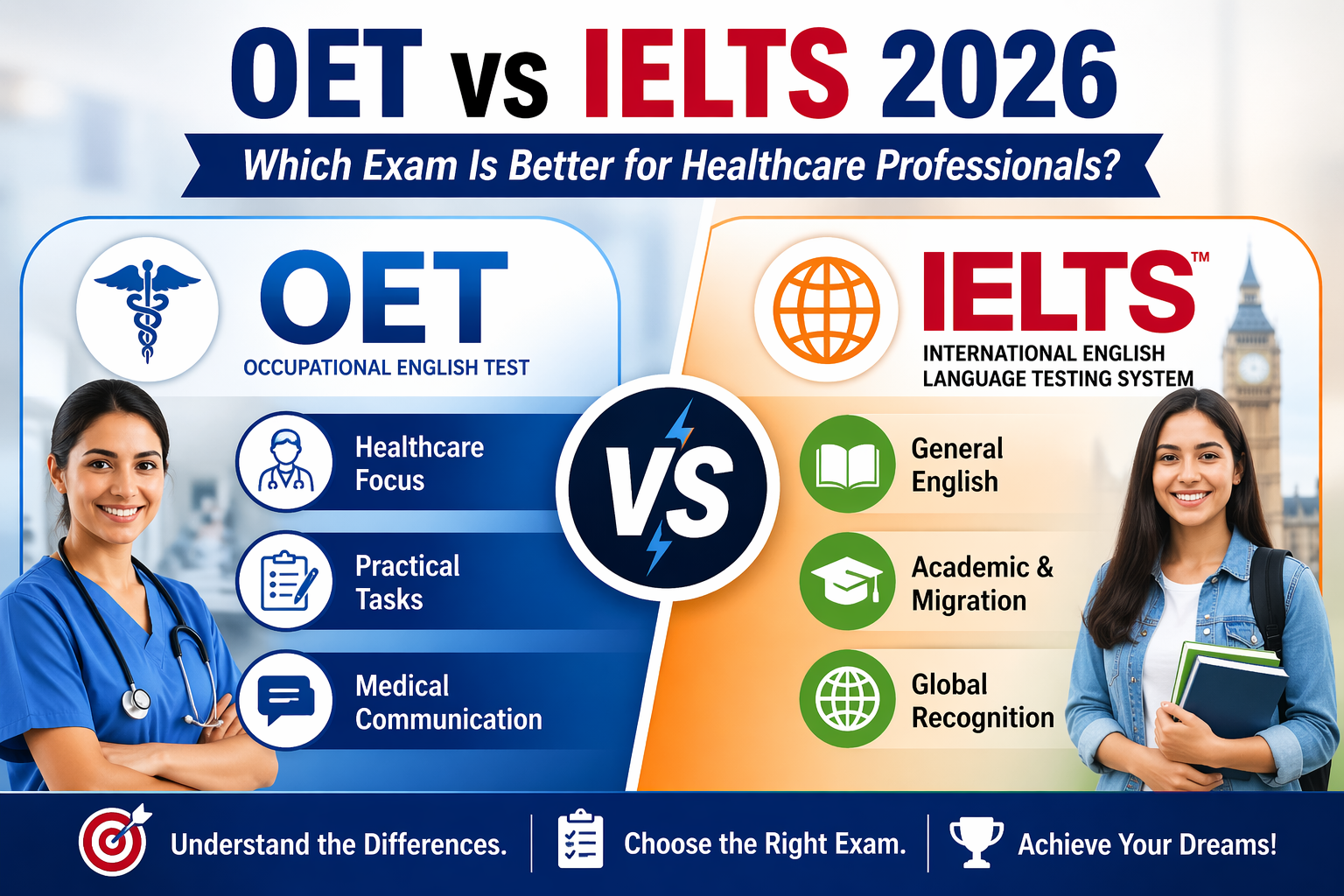
OET vs IELTS 2026: Which Exam Is Better for Healthcare Professionals?
Choosing between OET and IELTS can feel confusing, especially for healthcare professionals planning to work abroad. Since both exams assess English proficiency, many candidates struggle to decide which option aligns with their goals. Therefore, understanding the differences between OET vs IELTS is essential before starting your preparation.
While both exams are widely accepted, they serve different purposes. On one hand, OET focuses on healthcare communication. On the other hand, IELTS evaluates general English skills used in academic and professional settings. As a result, your decision should depend on your career path.
Designed specifically for medical professionals, the **Occupational English Test emphasizes real-world communication in healthcare environments. By contrast, the **International English Language Testing System targets a broader audience across multiple industries. Consequently, selecting the right exam can save both time and effort.
This guide provides a complete comparison of OET vs IELTS 2026, covering format, difficulty, scoring, and expert recommendations.
🟦 OET vs IELTS Overview (Comparison)
To begin with, let’s compare both exams at a glance.
| Feature | OET | IELTS |
|---|---|---|
| Focus | Healthcare communication | General English |
| Audience | Healthcare professionals | Students & professionals |
| Sections | Listening, Reading, Writing, Speaking | Listening, Reading, Writing, Speaking |
| Context | Medical scenarios | General topics |
Although both exams share a similar structure, their content differs significantly. Therefore, choosing the right one depends on your background and long-term goals.
🟦 What Is OET in the OET vs IELTS Debate
The Occupational English Test evaluates English skills within healthcare environments. Rather than relying on general topics, it focuses on communication in real medical situations.
For example, candidates may listen to patient consultations, write referral letters, or participate in role-play scenarios. Because of this practical structure, the exam feels highly relevant to healthcare professionals.
Another advantage is the use of familiar medical terminology. This familiarity makes tasks easier to understand and complete. As a result, many candidates feel more confident when preparing for OET.
🟦 What Is IELTS in the OET vs IELTS Comparison?
The International English Language Testing System measures general English proficiency for study, work, and migration.
Unlike OET, the exam includes a wide variety of topics that are not tied to any specific profession. Consequently, candidates must adapt to different contexts, including academic discussions and everyday conversations.
Additionally, IELTS offers both Academic and General Training formats. Because of this flexibility, it remains suitable for a wide range of goals.
🟦 Key Differences Between OET vs IELTS
🟨 1. OET vs IELTS: Purpose of the Exam
A major difference lies in the purpose of each test. OET is designed specifically for healthcare professionals and focuses on workplace communication.
In contrast, IELTS serves a broader audience. Because of this, it evaluates general English skills required for education, employment, and migration.
🟨 2. OET vs IELTS: Exam Format
Although both exams include four sections, the nature of their content differs.
Healthcare-based scenarios appear in OET tasks, while IELTS presents general topics from various fields. Due to this distinction, OET often feels more practical for medical candidates. For a detailed breakdown of the test structure, refer to the official OET exam format page.
🟨 3. OET vs IELTS: Difficulty Level
Many candidates ask which exam is easier. The answer depends largely on your background.
Healthcare professionals often find OET more manageable because it uses familiar terminology and realistic situations. On the other hand, IELTS may seem more challenging due to its broader and sometimes abstract topics.
Even so, strong general English skills can make IELTS equally manageable.
🟨 4. OET vs IELTS: Scoring System
Different scoring methods also set these exams apart. OET uses a scale from 0 to 500, which converts into grades from A to E. In contrast, IELTS uses a band score system ranging from 0 to 9.
Most healthcare institutions require Grade B in OET or Band 7 in IELTS. Therefore, understanding these benchmarks helps you set clear goals.
🟨 5. OET vs IELTS: Acceptance Worldwide
Acceptance varies depending on purpose and profession. Healthcare boards and medical councils recognize OET.
Meanwhile, universities, employers, and immigration authorities worldwide accept IELTS. As a result, your career goals should guide your decision.
🟦 OET vs IELTS Section-Wise Comparison
🟨 Listening
Patient consultations and healthcare discussions form the basis of OET listening tasks. In contrast, IELTS includes general conversations and lectures.
Because of this difference, OET tends to feel more relevant for medical professionals.
🟨 Reading
Healthcare-related texts dominate OET reading tasks. Meanwhile, IELTS includes academic or general passages.
Consequently, medical candidates often find OET reading more familiar and easier to navigate.
🟨 Writing
Professional medical letters are required in OET writing tasks. By comparison, IELTS focuses on essays and reports.
As a result, OET writing aligns more closely with real workplace communication.
🟨 Speaking
Role-play scenarios are central to OET speaking tasks, simulating real healthcare interactions. In contrast, IELTS uses a structured interview format.
This difference makes OET more practical for workplace communication.
🟦 Which Exam Is Easier: OET or IELTS?
The level of difficulty depends on your experience and strengths.
Healthcare professionals generally find OET easier because it uses familiar language and real-life scenarios. However, IELTS may suit candidates who are comfortable with general English topics.
Ultimately, the easier exam is the one that matches your preparation style.
🟦 OET vs IELTS: Which Should You Choose?
🟨 Choose OET If:
If you decide to take OET, understanding the OET exam fees is an important step.
- You are a healthcare professional
- You prefer practical communication tasks
- You want job-specific language skills
🟨 Choose IELTS If:
- You are applying to universities
- You need a general English test
- You are not in the healthcare field
🟦 Pros and Cons of OET vs IELTS
🟨 Advantages of OET
OET offers several benefits for healthcare professionals.
First, the exam uses profession-specific content, which makes it easier to relate to real work situations.
In addition, candidates complete practical tasks that reflect everyday communication in healthcare settings.
Because of this structure, many medical professionals find OET easier to understand and apply.
🟨 Disadvantages of OET
Despite its advantages, OET has some limitations.
One key drawback is that it is restricted to healthcare fields, which reduces its flexibility.
Moreover, the exam fee is slightly higher compared to other English tests.
As a result, some candidates may consider alternative options.
🟨 Advantages of IELTS
IELTS provides a wide range of benefits for different types of candidates.
For example, it is accepted worldwide by universities, employers, and immigration authorities.
Additionally, the test suits all professions, not just healthcare.
Because of its flexibility, IELTS remains a popular choice globally.
🟨 Disadvantages of IELTS
However, IELTS also has certain drawbacks.
Unlike OET, it does not focus on healthcare-specific communication.
Furthermore, candidates must deal with abstract and unfamiliar topics.
Consequently, some healthcare professionals find it less relevant to their needs.
🟦 OET vs IELTS Tips for Choosing the Right Exam
Making the right decision requires careful evaluation.
Start by considering your career goals. Next, review the requirements of your target country or institution. In addition, assess your strengths and comfort level.
Finally, take a sample test for both exams. Comparing your performance will help you choose confidently.
🟦 FAQs: OET vs IELTS
❓ Is OET accepted everywhere IELTS is?
No, OET is mainly accepted in healthcare sectors.
❓ Which exam is cheaper?
IELTS is usually more affordable.
❓ Can I switch from IELTS to OET?
Yes, many candidates switch depending on their goals.
❓ Which exam is better for nurses?
OET is generally more suitable for nurses.
🟢 Conclusion
Choosing between OET vs IELTS depends on your goals and professional background. While IELTS offers broader opportunities, OET provides a specialized approach for healthcare professionals.
If your aim is to work in the medical field, OET is often the better choice. On the other hand, IELTS remains ideal for academic and general purposes.
In the end, selecting the right exam simplifies your preparation and increases your chances of success. Once you choose OET, the next step is to follow a structured preparation plan.
Leave a Reply