FMGE Exam Syllabus 2026: Subject-Wise Topics & Weightage
The FMGE exam syllabus plays a vital role in preparing for the screening test required for foreign medical graduates to practice in India. Moreover, understanding subject-wise weightage and important topics can significantly improve your chances of success. The FMGE exam is conducted by the National Board of Examinations in Medical Sciences (NBEMS), which is responsible for regulating postgraduate medical exams in India.
Since the exam covers a wide range of medical subjects, a structured approach becomes essential. Therefore, focusing on high-yield areas while maintaining consistency can make preparation more effective. To understand how questions are distributed, you should also check the FMGE exam pattern.
🟦 FMGE Exam Syllabus 2026 Overview for Medical Graduates
The FMGE syllabus is based on the MBBS curriculum followed by the National Medical Commission (NMC). In other words, it includes all major subjects studied during undergraduate medical education.
However, instead of treating every subject equally, it is more efficient to divide them into three categories:
- Pre-clinical subjects
- Para-clinical subjects
- Clinical subjects
As a result, prioritization becomes easier and more strategic. The structure is similar to the NEET PG 2026 syllabus.
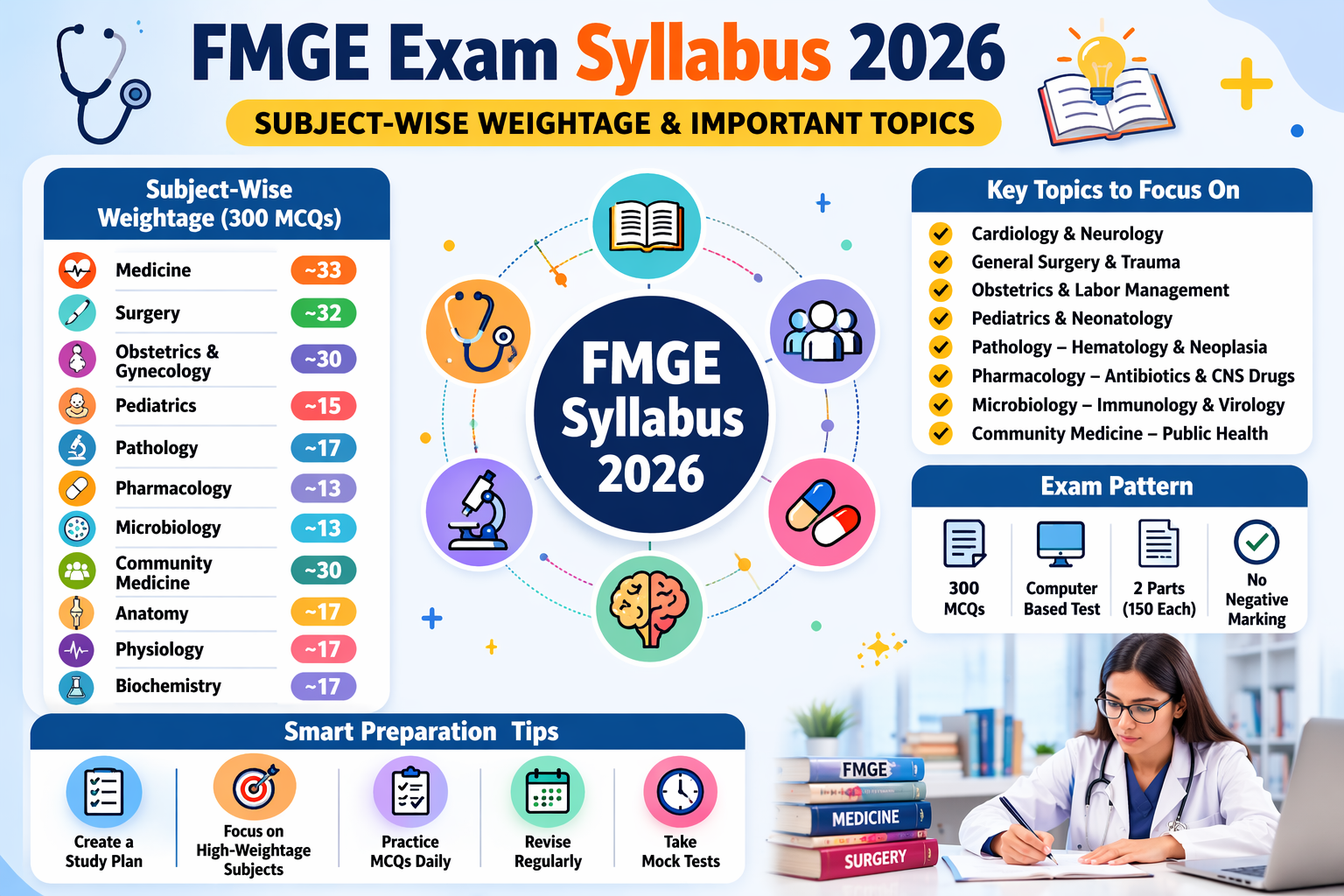
🟦 FMGE Exam Syllabus 2026: Subject-Wise Weightage & Marks Distribution
A clear understanding of subject weightage helps in planning preparation effectively.
🟨 FMGE Clinical Subjects Weightage in 2026 Syllabus
Clinical subjects contribute the highest number of questions. Therefore, focusing on these areas is crucial.
- Medicine – ~33 questions
- Surgery – ~32 questions
- Obstetrics & Gynecology – ~30 questions
- Pediatrics – ~15 questions
Consequently, mastering these subjects can significantly improve overall performance.
🟨 FMGE Para-Clinical Subjects in Exam Syllabus and Weightage
Para-clinical subjects connect theory with practical application. In addition, they are considered scoring if concepts are clear.
- Pathology – ~17 questions
- Pharmacology – ~13 questions
- Microbiology – ~13 questions
- Community Medicine – ~30 questions
As a result, regular revision of these subjects can lead to better accuracy.
🟨 FMGE Pre-Clinical Subjects in 2026 Syllabus Overview
Although these subjects carry relatively lower weightage, they remain important.
- Anatomy – ~17 questions
- Physiology – ~17 questions
- Biochemistry – ~17 questions
Therefore, skipping them entirely would reduce your overall score.
🟦 FMGE Exam Syllabus Subject-Wise: Important Topics to Focus On
Focusing on high-yield topics within each subject can simplify preparation and improve retention.
🟨 Important Anatomy Topics in FMGE Exam Syllabus 2026
Key areas include neuroanatomy, embryology, histology, and gross anatomy. Additionally, visual learning techniques such as diagrams can enhance understanding.
🟨 Physiology Important Topics
Important areas include the cardiovascular system, respiratory system, renal physiology, and endocrinology. Moreover, conceptual clarity is more valuable than rote memorization.
🟨 Biochemistry Important Topics
Core topics include metabolism, enzymes, molecular biology, and vitamins. In particular, metabolic pathways are frequently tested.
🟨 Pathology Important Topics
General pathology, hematology, and neoplasia are commonly asked topics. Furthermore, repeated revision helps in long-term retention.
🟨 Pharmacology Important Topics
Important areas include antibiotics, CNS drugs, and autonomic drugs. In addition, understanding drug mechanisms improves MCQ performance.
🟨 Microbiology Important Topics
Topics such as immunology, bacteriology, and virology are frequently tested. Therefore, consistent revision is essential.
🟨 Medicine Important Topics
Key areas include cardiology, neurology, and infectious diseases. As expected, this subject carries significant weightage.
🟨 Surgery Important Topics
Important areas include general surgery, trauma, and gastrointestinal surgery. Moreover, clinical application is often emphasized.
🟨 Obstetrics & Gynecology Topics
Focus areas include pregnancy complications, labor management, and gynecological disorders. In addition, case-based questions are common.
🟨 Pediatrics Important Topics
Growth and development, neonatology, and vaccination are essential topics. Therefore, understanding fundamentals is important.
🟦 FMGE Exam Pattern and Syllabus 2026 Explained
In addition to the syllabus, understanding the exam pattern is equally important.
- 300 multiple-choice questions
- Divided into two parts
- Computer-based test
- No negative marking
Consequently, attempting all questions increases your chances of scoring higher.
🟦 How to Cover FMGE Exam Syllabus 2026 Effectively for High Scores
Covering the entire syllabus may seem challenging at first. However, a structured approach can make it manageable.
🟨 Focus on High-Yield Subjects
Begin with clinical subjects such as Medicine and Surgery. Meanwhile, continue revising para-clinical subjects regularly.
🟨 Follow a Study Plan
A structured plan helps maintain consistency. For example, dividing preparation into daily targets and weekly revisions ensures steady progress.
🟨 Practice MCQs Regularly
Regular MCQ practice improves both speed and accuracy. In fact, it also helps identify weak areas quickly.
🟨 Revise Frequently
Frequent revision strengthens memory retention. Therefore, revisiting topics multiple times is essential.
🟦 Common Mistakes in FMGE Exam Syllabus Preparation to Avoid
Several common mistakes can reduce performance. For instance:
❌ Ignoring revision
❌ Avoiding MCQ practice
❌ Using too many resources
❌ Poor time management
As a result, even well-prepared students may struggle.
🟦 FMGE Exam Syllabus FAQs: Important Questions Answered
❓ Is FMGE syllabus the same as MBBS?
Yes, it is based on the MBBS curriculum.
❓ Which subjects are most important?
Clinical subjects carry the highest weightage.
❓ Is FMGE difficult to pass?
Although challenging, it is manageable with proper preparation.
🟢 Conclusion
In conclusion, the FMGE exam syllabus is extensive but manageable with the right strategy. Moreover, focusing on high-weightage topics and maintaining consistency can significantly improve results.
Ultimately, success depends on disciplined preparation, smart planning, and regular revision.