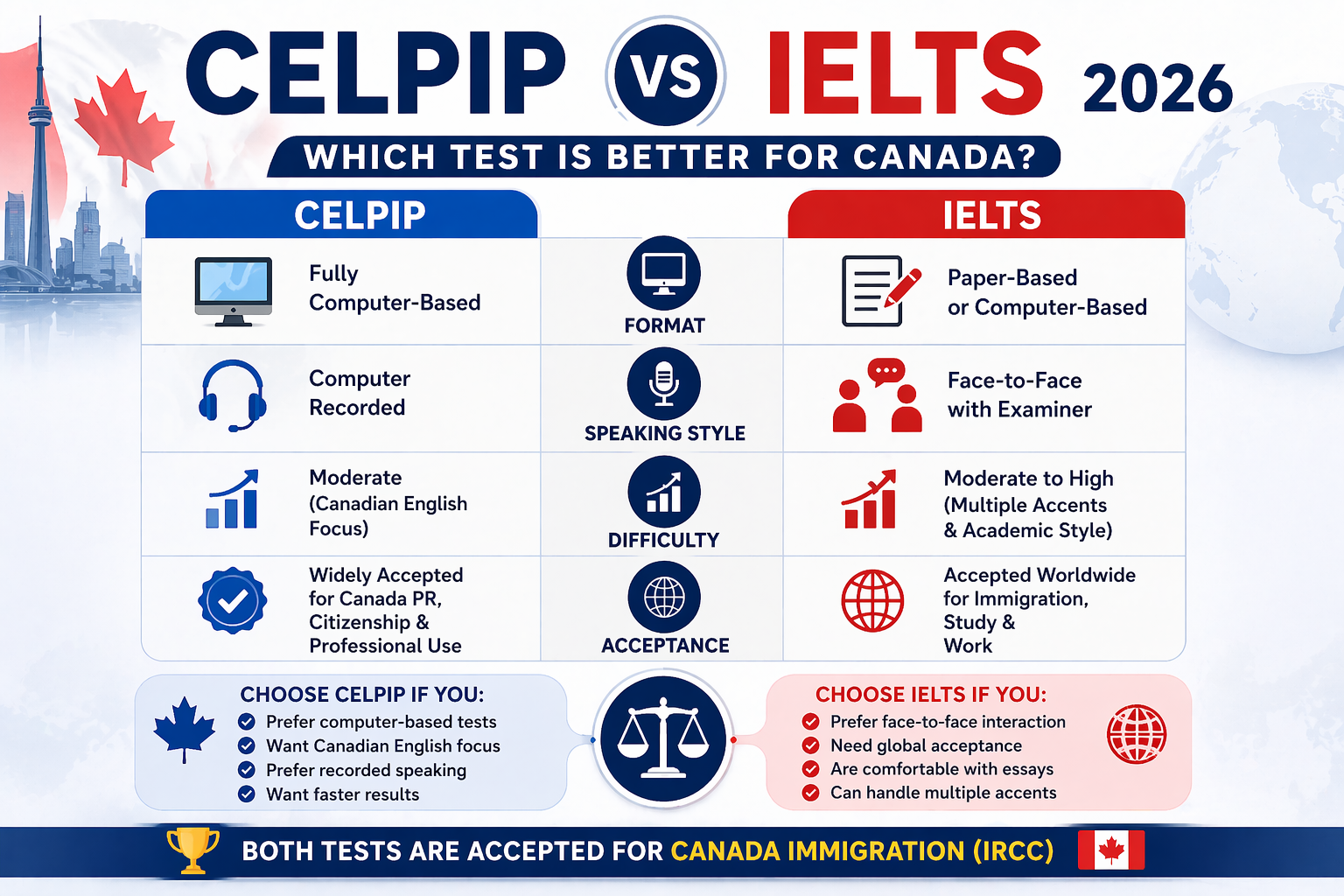
CELPIP vs IELTS 2026: Which Test is Better for Canada?
Choosing between CELPIP vs IELTS can feel overwhelming, especially if you plan to study, work, or immigrate to Canada. Both exams assess your English language skills, but they differ in format, difficulty level, and overall experience. Therefore, selecting the right test plays a crucial role in your success.
CELPIP focuses specifically on Canadian English and real-life situations. In contrast, IELTS serves a global audience and includes a wider range of accents and formats. As a result, your personal strengths and long-term goals should guide your decision.
Paragon Testing Enterprises conducts the CELPIP exam, while British Council, IDP Education, and Cambridge Assessment English manage IELTS. In addition, Immigration, Refugees and Citizenship Canada (IRCC) accepts both exams for immigration and citizenship purposes.
In this detailed guide, you will explore every aspect of CELPIP vs IELTS, including format, scoring, difficulty, fees, advantages, and expert tips. By the end, you will clearly understand which test suits you best. If you choose CELPIP, start with this complete CELPIP exam guide to understand the structure.
🟦 CELPIP vs IELTS: Quick Comparison
Before diving deeper, let’s look at a quick comparison:
| Feature | CELPIP | IELTS |
|---|---|---|
| Mode | Fully computer-based | Paper + Computer |
| Speaking | Computer recorded | Face-to-face |
| Duration | ~3 hours | ~2 hours 45 mins |
| Focus | Canadian English | Global English |
| Availability | Limited countries | Worldwide |
Although both exams measure English proficiency effectively, they offer different experiences. Therefore, understanding these differences helps you make a smarter choice.
🟦 CELPIP vs IELTS: Exam Format Explained
Understanding the exam structure is essential before choosing a test. Each exam includes four sections, but the format differs significantly.
🟨 CELPIP Exam Format
CELPIP includes:
- Listening
- Reading
- Writing
- Speaking
You complete the entire exam in one sitting, which makes it more convenient for many candidates. Moreover, the computer-based format allows you to type answers directly, reducing handwriting issues.
In addition, the test focuses on real-life situations, such as emails and conversations. As a result, many candidates find it practical and easier to relate to.
🟨 IELTS Exam Format
IELTS also includes:
- Listening
- Reading
- Writing
- Speaking
However, the speaking test involves a face-to-face conversation with an examiner. Furthermore, you can choose between paper-based and computer-based formats.
Because of this flexibility, IELTS suits candidates with different preferences. At the same time, the human interaction in speaking may feel challenging for some.
🟦 CELPIP vs IELTS: Section-wise Comparison
A detailed section-wise comparison helps you understand the real differences.
🟨 Speaking Section
CELPIP records your responses through a computer. You speak into a microphone without interacting with a person. Therefore, this format suits candidates who feel nervous during face-to-face conversations.
On the other hand, IELTS requires direct interaction with an examiner. As a result, candidates who communicate confidently in person may perform better.
🟨 Listening Section
CELPIP uses mostly Canadian accents. Consequently, it feels more predictable and easier for many candidates.
In contrast, IELTS includes multiple accents, such as British and Australian. Therefore, it can feel more challenging if you are not familiar with different pronunciations.
🟨 Reading Section
CELPIP provides practical and straightforward reading passages. As a result, candidates often find it easier to understand.
IELTS includes academic and general passages. Therefore, it may require stronger reading skills and vocabulary.
🟨 Writing Section
CELPIP focuses on real-life tasks such as writing emails and survey responses. Because of this, candidates can relate more easily to the topics.
IELTS requires essay writing and formal responses. Consequently, it demands stronger structure and advanced vocabulary.
🟦 CELPIP vs IELTS: Scoring System
Understanding the scoring system helps you set realistic goals.
🟨 CELPIP Scoring
CELPIP uses a scale from 1 to 12 for each section. This system makes it easy to understand your performance level.
🟨 IELTS Scoring
IELTS uses band scores from 0 to 9. It also includes half-band scores such as 6.5 or 7.5.
🟨 Score Comparison
Both scoring systems differ, but institutions and immigration authorities accept them equally. Therefore, you should not choose a test based on scoring alone.
🟦 CELPIP vs IELTS: Difficulty Level
Many candidates ask which test is easier. However, the answer depends on your strengths.
CELPIP feels easier for candidates comfortable with computers and Canadian English. In addition, its predictable format makes preparation simpler.
IELTS, on the other hand, suits candidates who prefer face-to-face communication and traditional exams. However, the variety of accents and writing tasks can increase difficulty.
Ultimately, your personal skills determine which test feels easier. To prepare effectively, follow a structured CELPIP study plan.
🟦 CELPIP vs IELTS: Fees
Both exams cost a similar amount, although prices vary slightly by location.
- CELPIP: Around $280–$300 CAD
- IELTS: Around $250–$300 USD
Since the difference is minimal, cost should not be your main deciding factor.
🟦 CELPIP vs IELTS: Acceptance and Recognition
Acceptance plays a major role in your decision.
Immigration, Refugees and Citizenship Canada accepts both CELPIP and IELTS for immigration and citizenship.
However, IELTS has global recognition and is accepted in countries like the UK, Australia, and the USA. In contrast, CELPIP mainly serves Canada.
Therefore, if you plan to move beyond Canada, IELTS may offer more flexibility.
🟦 Advantages of CELPIP
CELPIP offers several benefits:
- Fully computer-based format
- Faster results
- Simple and practical tasks
- No face-to-face speaking
Because of these advantages, many candidates find it more comfortable.
🟦 Advantages of IELTS
IELTS also provides strong benefits:
- Global acceptance
- Flexible test formats
- Face-to-face speaking interaction
- Widely recognized by universities
As a result, it remains a popular choice worldwide.
🟦 When to Choose CELPIP
You should choose CELPIP if you:
- Prefer typing over writing
- Feel nervous during face-to-face speaking
- Want a Canada-focused exam
- Prefer practical, real-life questions
🟦 When to Choose IELTS
You should choose IELTS if you:
- Prefer speaking with an examiner
- Need global recognition
- Feel comfortable with academic writing
- Can handle multiple accents
🟦 Tips to Choose Between CELPIP vs IELTS
Making the right choice requires careful evaluation.
First, identify your strengths. For example, strong typing skills make CELPIP easier.
Next, consider your goals. If you plan to study abroad, IELTS may be more suitable.
Finally, try sample tests from both exams. As a result, you can experience the format before deciding.
🟦 Common Mistakes When Choosing
Many candidates make mistakes due to lack of research.
Some choose IELTS without understanding the speaking format. Others select CELPIP without practicing typing.
To avoid these mistakes, always test both formats before making a decision.
🟦 CELPIP vs IELTS FAQs
❓ Which test is easier?
The easier test depends on your skills and preferences.
❓ Is CELPIP accepted worldwide?
No, it is mainly accepted in Canada.
❓ Is IELTS better for immigration?
Both tests work for immigration, but IELTS offers wider recognition.
❓ Can I switch tests later?
Yes, but choosing early helps you prepare more effectively.
🟢 Conclusion
Choosing between CELPIP vs IELTS depends on your personal strengths, goals, and preferences. CELPIP offers a computer-based experience tailored for Canada, while IELTS provides global recognition and flexibility.
Both exams provide reliable results. Therefore, you should choose the test that aligns with your preparation style and future plans. Once you decide, improve your score with a CELPIP practice test.
Leave a Reply